
| Quick Answer: SEER2 vs SEER Difference
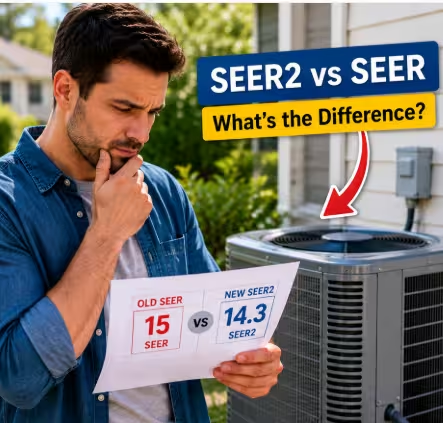
SEER2 is the updated AC efficiency rating introduced by the U.S. Department of Energy in January 2023. It uses a tougher test that better reflects real-world conditions. Because the test is harder, SEER2 numbers run about 4.5% to 5% lower than old SEER numbers — even for the exact same equipment. So your new 14.3 SEER2 unit is not less efficient than an old 15 SEER model. It is actually slightly more efficient. The yardstick changed. The equipment did not. |
Why Homeowners Are Confused Right Now
You just replaced your 15-year-old air conditioner. The contractor hands over the paperwork, and you notice something strange. The new unit shows a 14.3 SEER2 rating. Your old one said 15 SEER. Your brain does the math and lands on the wrong answer.
That feeling that the new system downgraded is one of the most common misconceptions in the HVAC industry right now. Millions of homeowners across the USA are seeing it. And it makes sense, because nobody explained what SEER2 actually is.
Here is the short version: the SEER2 vs SEER difference is not about efficiency. It is about honesty. The old SEER test was run in conditions so ideal they barely resembled your home. The new SEER2 test fixes that. As a result, the number looks lower on paper but the performance in your home is more accurately described than ever before.
This guide breaks it all down in plain language. No engineering degree required.
What Is SEER? The Original Rating Explained
SEER stands for Seasonal Energy Efficiency Ratio. At its core, it answers one question: how much cooling does your AC produce for every unit of electricity it uses?
The U.S. Department of Energy (DOE) created the SEER standard so that consumers could compare different AC models using one consistent number. Think of it like the miles-per-gallon rating on a car. A higher SEER means the system uses less electricity to deliver the same amount of cooling.
For decades, SEER served its purpose. But it had a quiet problem that grew harder to ignore.
The Hidden Flaw in the Old SEER Test
The original SEER rating was calculated under near-perfect laboratory conditions. Static pressure the resistance that air faces as it moves through your ductwork, was set at just 0.1 inches of water column. That is an almost friction-free environment.
Real homes do not work that way. Your ducts have bends, joints, restrictions, and sometimes small leaks. The actual static pressure your blower motor fights every day is far closer to 0.5 inches of water column. The old test simply did not account for that.
In short, the efficiency your AC earned in the lab was not the efficiency you experienced in your living room. The gap between the rating and reality was real — and the DOE decided to close it.
What Is SEER2? The Updated Standard Explained
SEER2 Seasonal Energy Efficiency Ratio 2 is the DOE’s updated testing standard for air conditioners and heat pumps. It became mandatory for all new equipment manufactured after January 1, 2023.
The core change is straightforward. The new M1 testing procedure raises the external static pressure requirement from 0.1 to 0.5 inches of water column a five-fold increase. This single adjustment makes the test dramatically more realistic, because it forces manufacturers to measure efficiency under conditions that actually resemble an installed home system.
| What Is SEER2? The One-Sentence Definition
SEER2 is the updated DOE efficiency rating for air conditioners and heat pumps, tested under higher static pressure conditions (0.5 in. vs the old 0.1 in.) to more accurately reflect how equipment performs after installation in a real home. |
Think of it this way. The old SEER test was like timing an athlete running a 100-meter dash on a perfectly smooth indoor track with no wind. SEER2 is the same athlete running the same distance outdoors, into a light headwind. The athlete’s fitness has not changed. But the score now reflects what actually happens in the field.
Because the test is harder, the numerical rating for the same piece of equipment drops by approximately 4.5% to 5%. That is the entire SEER2 vs SEER difference in a single sentence.
SEER to SEER2 Conversion Chart
Use this table to compare your old equipment’s SEER rating against current SEER2 equivalents. The conversion formula is: SEER2 = SEER divided by 1.05.
| Old SEER Rating | SEER2 Equivalent | Efficiency Change |
| 13 SEER | 12.4 SEER2 | Below 2023 minimums cannot be installed new |
| 14 SEER | 13.4 SEER2 | Northern minimum baseline |
| 15 SEER | 14.3 SEER2 | South/Southwest minimum baseline |
| 16 SEER | 15.2 SEER2 | Mid-range efficiency |
| 17 SEER | 16.2 SEER2 | Good efficiency — qualifies for some IRA credits |
| 18 SEER | 17.1 SEER2 | High efficiency — strong ROI in hot climates |
| 20 SEER | 19.0 SEER2 | Premium tier |
| 21+ SEER | 20+ SEER2 | Ultra-premium best for large homes, long ownership |
Why the Numbers Dropped And Why That Is Good News
When SEER2 rolled out, a predictable thing happened. Homeowners saw lower numbers and assumed something got worse. In reality, the opposite is true.
Here is a concrete example. A 17 SEER2 unit is more efficient than a 17 SEER unit, not less. Under the old SEER method, that same physical equipment would have been rated around 18 SEER. The 17 SEER2 reflects a harder, more honest test but the energy savings in your home are higher than the old 17 SEER would have predicted.
Bottom line: A matching number in SEER2 means better real-world performance than the same number in SEER. Comparing a 2026 14.3 SEER2 unit against a 2019 14 SEER unit? The SEER2 unit wins on actual home efficiency.
2026 Regional Minimums: What You Are Required to Buy
The DOE does not enforce a single national SEER2 floor. Instead, it divides the USA into three climate regions, each with its own minimum requirement. Installing below your region’s minimum is a federal violation it can void your warranty and disqualify you from rebates.
| Region | States Included | Min. SEER2 (Split AC) | Min. SEER2 (Heat Pump) | Min. HSPF2 |
| North | Most northern states (MN, WI, MI, NY, PA, etc.) | 13.4 | 14.3 | 7.5 |
| Southeast | VA, NC, SC, GA, FL, AL, MS, TN, AR, LA, OK, TX (east) | 14.3 | 14.3 | 7.5 |
| Southwest | NM, AZ, NV, CA, HI, TX (west) | 14.3 | 14.3 | 7.5 + EER2 req. |
Packaged units where the compressor and air handler are housed together follow a nationwide minimum of 13.4 SEER2 regardless of region.
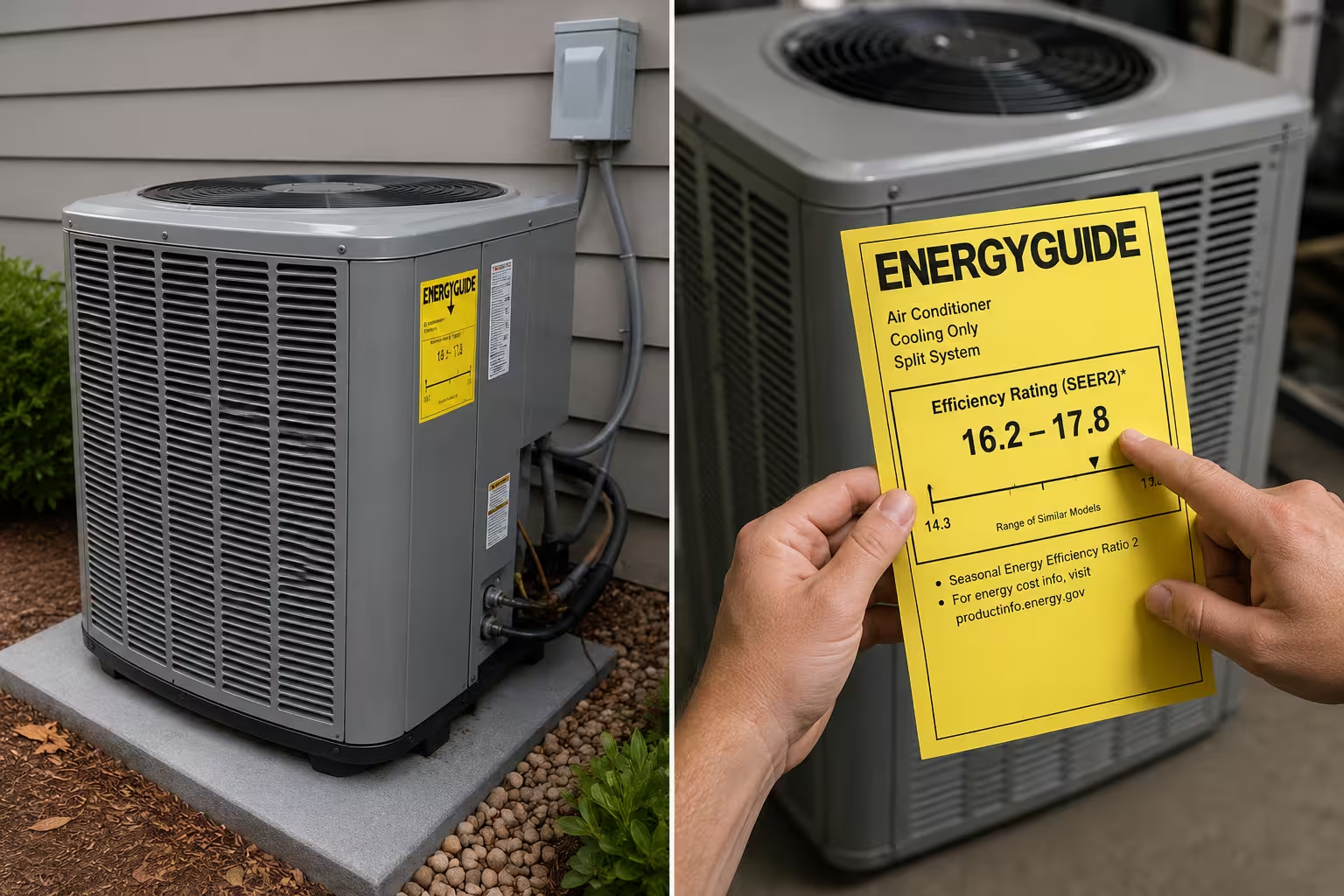
Heat pumps use both a SEER2 rating (for cooling) and an HSPF2 rating (for heating). When you see both numbers on a label, the system qualifies under both standards.
What Is a Good SEER2 Rating for Your Home?
The answer depends on three things: where you live, how long your cooling season runs, and how long you plan to stay in the home. There is no single right answer, but the framework below covers most situations.
| Climate Profile | Recommended SEER2 | Why |
| Hot, long summers (FL, TX, AZ, CA) | 16 – 18 SEER2 | High cooling hours mean faster ROI on efficient equipment |
| Moderate summers (mid-Atlantic, Midwest) | 14.3 – 16 SEER2 | Balanced investment; ultra-high ratings have long payback |
| Mild, short summers (northern states) | 13.4 – 15.2 SEER2 | Payback on premium units can exceed 10 years |
| Any region — low bills priority / IRA credits | 16+ SEER2 | Federal tax credit threshold; better utility rebate eligibility |
| Large home (2,500+ sq ft), long ownership | 17 – 20 SEER2 | Compounding savings justify higher upfront cost |
| Real-World Savings Example
A Florida homeowner replacing a 10 SEER system (installed 2008) with an 18 SEER2 variable-speed unit can expect to cut cooling energy use by 40% to 50%. At the average U.S. residential electricity rate of $0.16/kWh, that translates to roughly $400 to $600 per year in savings before any utility rebates or federal tax credits. Payback on the premium over a standard 14.3 SEER2 model: under 5 years in most Florida climate zones. |
IRA Tax Credits and SEER2: How to Qualify
The Inflation Reduction Act (IRA) created federal tax credits for high-efficiency HVAC equipment. To access these credits, your new system must meet SEER2 thresholds set by ENERGY STAR and the DOE.
- Central air conditioners: Must achieve 16 SEER2 or higher to qualify for the 25C tax credit (up to $600)
- Heat pumps: Must meet ENERGY STAR criteria typically 15.2 SEER2 and 7.5 HSPF2 minimum — for the 25C credit (up to $2,000)
- Geothermal heat pumps: Must meet ENERGY STAR standards to qualify for a 30% tax credit with no cap
- Ductless mini-splits: Many models exceed 20 SEER2 and qualify easily, since they bypass ductwork static pressure losses entirely
Important: Always verify current credit amounts with a tax professional or at energystar.gov/taxcredits, as IRA program rules may change after publication date.
Why Mini-Splits Dominate the SEER2 Ratings Chart
If you have compared SEER2 ratings between central air conditioners and ductless mini-splits, you have probably noticed something striking. A standard central AC struggles to crack 17 SEER2. A mid-range mini-split often sits at 19, 20, or even 22 SEER2.
The reason comes directly from the test design. The M1 procedure penalises systems that have to push air through ductwork at 0.5 inches of static pressure. Mini-splits avoid this entirely; there are no ducts. No ductwork means no duct losses, no static pressure drag, and no thermal loss from ducts running through unconditioned attic space.
However, SEER2 rating alone does not decide whether a mini-split is right for your home. Central systems work better for whole-home conditioning where existing ductwork is in good condition. Mini-splits are often the smarter choice for room additions, sunrooms, garages, or homes without existing ducts.
Do You Need to Replace Your Old SEER-Rated System?
No. The SEER2 regulations apply to the manufacture and installation of new equipment. Your existing system whether it was installed in 2010 or 2019 — is grandfathered in and fully legal to operate.
That said, if your current system is 10 to 15 years old, the efficiency gap between what you have and what is available today is significant. A unit installed in 2008 at 10 SEER was meeting the federal minimum of its time. Today, that same system looks like this compared to the 2026 baseline:
| System Age | Typical SEER Rating | SEER2 Equivalent | vs. 2026 Minimum | Potential Savings on Upgrade |
| Pre-2006 | 8 – 10 SEER | 7.6 – 9.5 SEER2 | ~35% below minimum | Up to 50% reduction in cooling costs |
| 2006 – 2014 | 13 – 14 SEER | 12.4 – 13.4 SEER2 | At or below minimum | 20% – 35% reduction in cooling costs |
| 2015 – 2022 | 14 – 16 SEER | 13.4 – 15.2 SEER2 | At or near minimum | 10% – 20% reduction in cooling costs |
| 2023 – present | 14.3+ SEER2 | Current standard | Compliant | Already optimized |
The decision to replace early comes down to two factors: repair frequency and climate. If you are paying for repairs every 12 to 18 months on an aging system, and you live in a climate where air conditioning runs 6 or more months per year, the math almost always favors replacement. A newer SEER2-rated system will pay its own way through energy savings faster than you might expect.
HSPF2: The Heating Companion to SEER2
If you are buying a heat pump rather than a standalone air conditioner, you will see two ratings on the label: SEER2 for cooling efficiency and HSPF2 for heating efficiency.
HSPF stands for Heating Seasonal Performance Factor. Like SEER, it was updated to HSPF2 using the same M1 testing procedure. The result is the same: HSPF2 numbers run roughly 15% lower than old HSPF numbers for the same equipment.
The 2026 federal minimum for heat pump heating efficiency is 7.5 HSPF2 in all regions. For IRA tax credit eligibility, most programmes require a higher threshold, typically around 8.1 HSPF2 or higher. Always check current ENERGY STAR requirements before purchasing.
SEER2 Buyer Checklist: 6 Steps Before You Sign Anything
Use this checklist before committing to a new AC or heat pump purchase. It takes less than 10 minutes and protects you from the most common mistakes.
- Confirm your DOE climate region (North, Southeast, or Southwest) and the applicable SEER2 minimum for your equipment type.
- Ask the contractor to provide the AHRI-certified SEER2 rating not a SEER rating, not a marketing estimate. Verify it at ahridirectory.org.
- Calculate your payback period on any upgrade above the minimum. A good rule: divide the extra upfront cost by your estimated annual savings.
- Check ENERGY STAR eligibility for the specific model to confirm IRA federal tax credit and local utility rebate qualification.
- Confirm the equipment uses the current approved refrigerant most 2026 systems have transitioned to R-454B, which carries lower global warming potential than the phased-out R-410A.
- Request a Manual J load calculation before installation. Proper sizing matters more than the SEER2 number on the box. An oversized system will short-cycle and underperform regardless of its rating.
Ready to Find the Right SEER2 System for Your Home?
Understanding the SEER2 vs SEER difference is the first step. The second step is matching the right system to your specific home, climate, and budget.
Here is what to do before your next HVAC consultation:
- Write down your current system’s SEER rating and installation year
- Identify your DOE climate region (North, Southeast, or Southwest)
- Set a target payback period 5 to 7 years works for most homeowners
- Check the ENERGY STAR certified product list for models that qualify for IRA credits
- Ask your contractor for a Manual J load calculation to confirm proper sizing
Choosing the right SEER2 system now means lower energy bills for the next 15 to 20 years. The investment pays for itself you just need the right information to start.
