
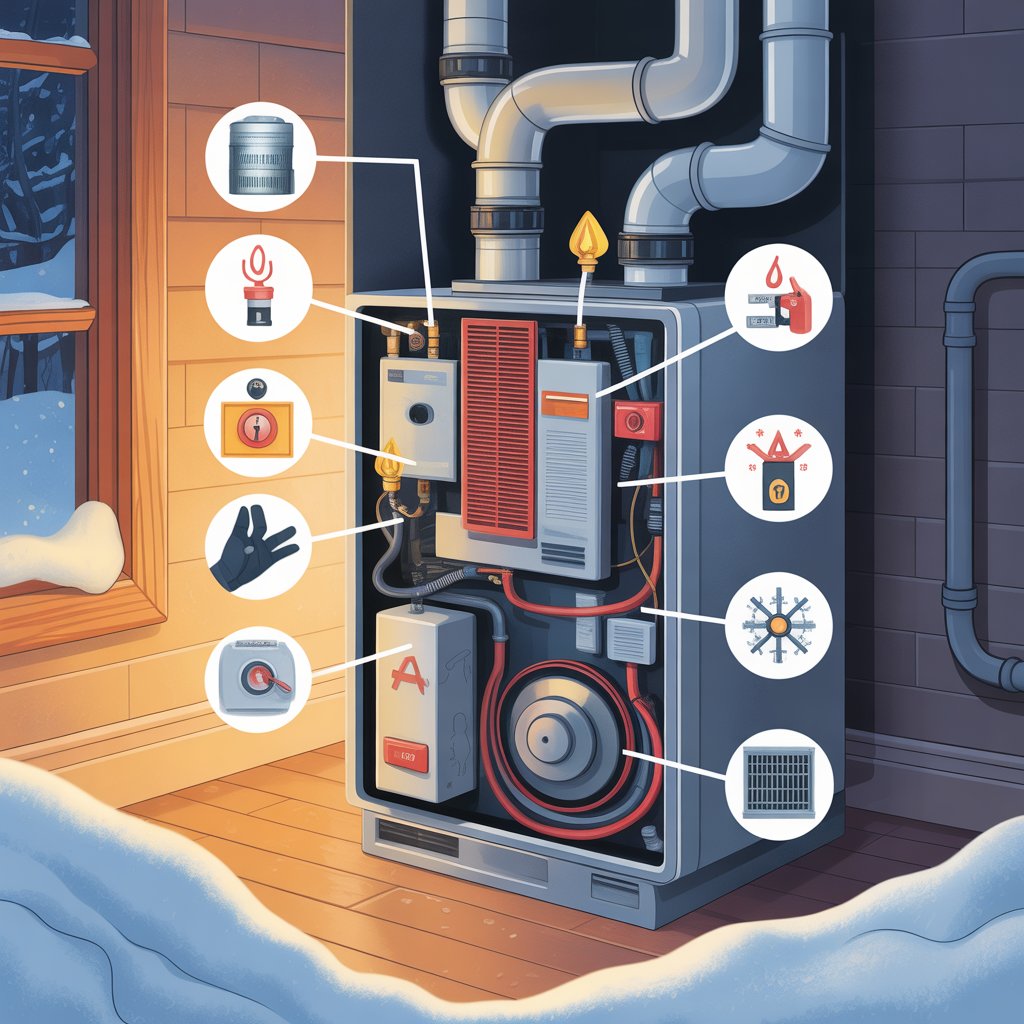
Most homeowners assume their furnace failed because it is old or low quality. The timing always in winter feels cruel but random. It is neither. There is a precise mechanical and thermal reason why furnaces collapse during the coldest days of the year, and understanding this changes how you prepare and respond.
When outdoor temperatures fall below 20°F, your furnace does not simply run more often it runs in longer, uninterrupted cycles under sustained thermal load. Components that could tolerate short bursts of heat all autumn are now asked to hold that load for hours. Heat exchangers that showed hairline stress fractures in November crack through in January. Ignitor elements that were already drawing 10–15% more amperage than spec finally burn out at 2 a.m. during a polar vortex.
There is also a pressure imbalance issue that almost no consumer resource discusses: in extremely cold weather, the pressure differential between indoors and outdoors increases significantly. This pulls more air through every gap in your duct system, forces your blower motor to compensate, and can cause flame rollout in older heat exchangers. What looks like an ignition failure is sometimes a combustion air starvation issue caused entirely by cold-weather physics.
| Field Expert Insight:
“The single most overlooked factor in winter furnace failure is stack effect pressure. When it’s -10°F outside and 70°F inside, your home becomes a low-pressure chimney. That suction starves combustion air, trips safety switches, and gets misdiagnosed as an ignitor fault 30% of the time in my experience.” — Marcus D. Holloway, Senior HVAC Field Technician |
Additionally, winter is when condensate drain lines freeze in high-efficiency (90%+) furnaces. These units produce acidic water vapor as a byproduct of secondary heat exchange. In a well-insulated mechanical room, the drain works fine. But when the line runs through an exterior wall or unheated crawl space, it freezes solid, backs up, and triggers the pressure switch fault a complete furnace lockout that often looks catastrophic but is a 20-minute fix if you know where to look.
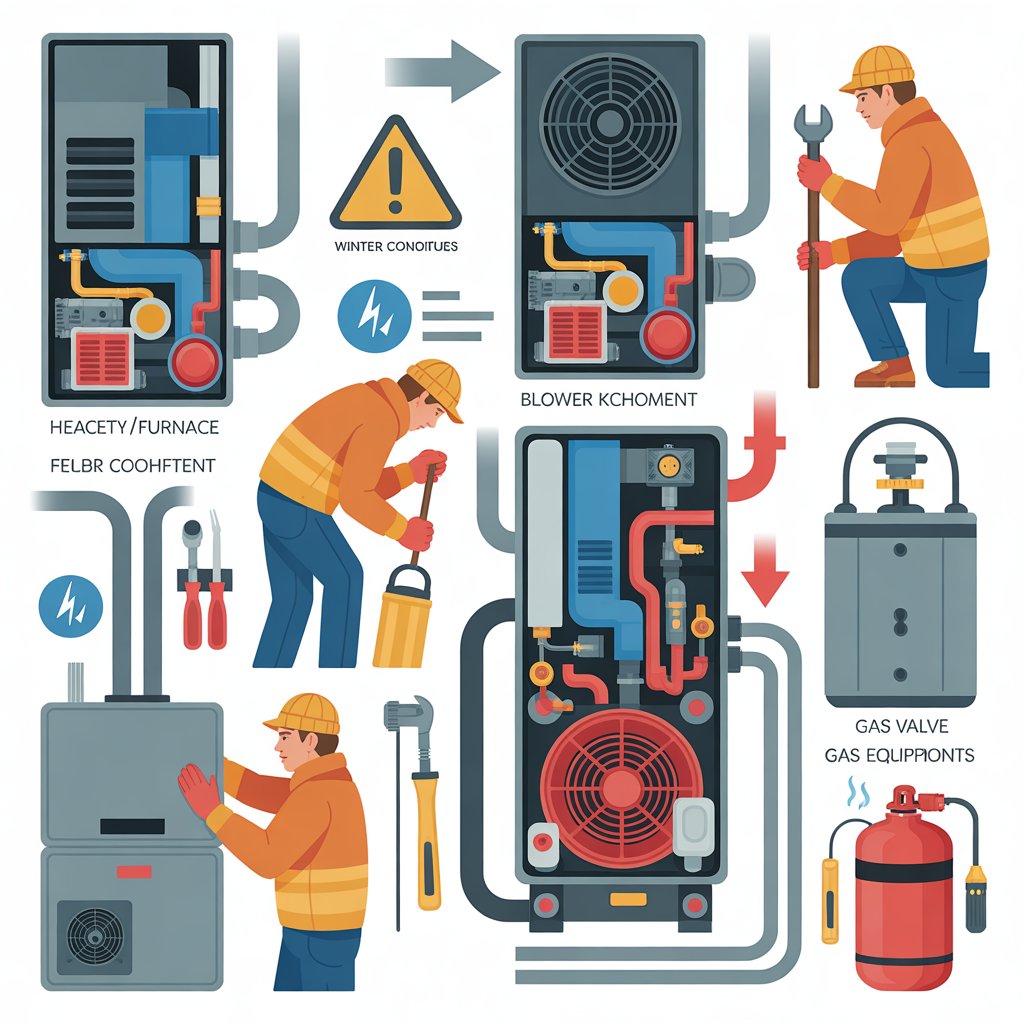
2. 7 Warning Signs Your Furnace Is About to Fail
Emergency furnace repair feels like it comes without warning. It rarely does. These are the signals most homeowners dismiss in November that become a 3 a.m. crisis in February.
1. Short Cycling (Runs Under 5 Minutes)
If your furnace fires up, runs for less than 5 minutes, and shuts off repeatedly, the heat exchanger is likely overheating or the flame sensor is fouled. Do not ignore this pattern.
2. Uneven Heat Across Rooms
One bedroom cold while the living room is roasting usually points to a failing zone valve, cracked duct, or a blower motor losing RPM capacity under sustained load.
3. Banging, Rumbling, or Scraping Sounds
Banging on startup means delayed ignition unburned gas accumulates before ignition fires. This is a safety issue and a sign the ignitor is degrading rapidly.
4. Yellow or Flickering Burner Flame
A healthy gas burner burns steady blue. Yellow or orange flame indicates incomplete combustion, which produces carbon monoxide. This is a health emergency, not just a repair issue.
5. Water Pooling Around the Furnace
In 90%+ efficiency units, this is almost always a condensate drain issue. In older units, it may indicate a cracked secondary heat exchanger do not run that furnace.
6. Gas Bill Spike With No Usage Change
A sudden 20–40% increase in your gas bill without behavioral change often precedes heat exchanger failure by 2–6 weeks. The furnace is burning more gas to produce the same heat output.
7. Thermostat Calls Running Noticeably Longer
If your home takes longer to reach set temperature on the same outdoor conditions as last year, combustion efficiency has dropped. This is measurable proof of internal decline.
| Pro Tip — The 3°F Delta Rule:
Stand in front of a supply register with a digital thermometer. Air coming out should be 50–70°F warmer than your return air temperature. If the delta is under 40°F on a full heating call, your heat exchanger or burner assembly is degraded. Do this check before winter hits. |
3. What to Do the Moment Your Furnace Stops Working
The first 15 minutes after your furnace stops determine how dangerous and expensive the next 12 hours will be. Work through this sequence before calling a repair company.
- Step 1: Check the thermostat actually check it
Confirm it is set to Heat (not Cool or Fan), the set point is at least 5°F above room temperature, and the display is on. Replace batteries even if you think they are fine low battery voltage causes 11% of all furnace outage service calls.
- Step 2: Check the furnace switch and circuit breaker
There is a wall switch near the furnace that looks like a light switch often accidentally flipped. Your electrical panel should show no tripped breaker on the furnace circuit. Reset once only. If it trips again, stop and call.
- Step 3: Check your air filter immediately
A completely clogged filter causes the heat exchanger to overheat and trips the high-limit safety switch. Pull the filter. If it is gray-black and you cannot see light through it, replace it. Then turn the furnace off for 30 minutes before restarting to let the limit switch reset.
- Step 4: Check the condensate drain (high-efficiency units)
Find the white PVC drain line exiting the furnace. Is there standing water in the trap? Is the line frozen near an exterior wall? Clear or thaw it carefully and check if the furnace restores operation.
- Step 5: Look for a blinking error code
Most modern furnace control boards flash LED error codes. Count the blinks. The sequence is usually printed on a sticker inside the furnace door. This code saves your technician 30 minutes of diagnostic time and reduces your service bill.
- Step 6: Protect your pipes before they freeze
Open cabinet doors under sinks on exterior walls. Let a faucet drip slowly. Move vulnerable pets, plants, and temperature-sensitive medications. Call a plumber proactively if indoor temperatures will drop below 45°F within 4 hours.
- Step 7: Call for emergency service with information ready
Have your furnace brand, model number, and error code ready. Tell the dispatcher your indoor temperature and how fast it is dropping. This determines dispatch priority in severe weather.
| Carbon Monoxide Warning Read Before Using Space Heaters:
Never use gas ranges, portable propane heaters, or barbecue grills indoors as heat sources. Only use UL-listed electric space heaters rated for indoor use. If your CO detector sounds at any point during a furnace failure, evacuate immediately and call 911 not the HVAC company. |
4. Safe DIY Checks Before the Technician Arrives
These checks are within homeowner scope and often resolve the issue entirely, saving hundreds of dollars on a service call.
The Ignitor Visual Test
Turn your furnace to heat call. Watch through the sight glass (the small glass port on the burner door). You should see the ignitor glow bright orange-white within 30–60 seconds. If it glows dimly or not at all, the ignitor is failing. Part cost: $15–$45. Total labor if you call a tech: $150–$220.
The Flame Sensor Clean
A flame sensor is a thin metal rod in the burner assembly. Oxides build up on it seasonally, causing the furnace to shut off 30 seconds after ignition. With the furnace off and power disconnected, pull the sensor and gently rub the metal rod with fine steel wool. This clears the issue in approximately 40% of short-cycling service calls and is the one DIY fix that technicians consistently confirm is safe for careful homeowners.
The Pressure Switch Hose Check
On 90%+ efficiency furnaces, a small rubber hose runs from the inducer motor to the pressure switch. A crack in this hose causes a pressure fault and complete lockout. Visually inspect the hose for splits near connection points. This hose costs under $3 at any hardware store.
Insider Note What “5 Blinks” Actually Means:Different manufacturers assign different meanings to the same blink code. 5 blinks on a Carrier = flame sense failure. 5 blinks on a Lennox = pressure switch fault open. 5 blinks on a Goodman = limit switch open. Always reference the sticker on YOUR furnace door never a generic online chart. |
5. Emergency Furnace Repair Costs: The Honest Breakdown
Here is a real-world breakdown that accounts for after-hours labor, part markup, and regional variation not the overly wide ranges found in most online resources.
| Repair Type | Part Cost | Standard Hours | After-Hours Emergency | Urgency |
| Ignitor replacement | $15–$55 | $130–$180 | $230–$320 | High — furnace won’t fire |
| Flame sensor cleaning/replacement | $8–$35 | $90–$150 | $180–$260 | High — 30-sec shutoff cycle |
| Inducer motor replacement | $180–$400 | $220–$350 | $420–$700 | High — no combustion airflow |
| Limit switch replacement | $20–$65 | $120–$200 | $200–$350 | Moderate |
| Condensate drain clearing | $0–$30 | $75–$130 | $150–$230 | High in 90%+ units |
| Control board replacement | $200–$600 | $250–$400 | $500–$900 | Critical — complete failure |
| Gas valve replacement | $200–$450 | $300–$450 | $550–$900 | Critical — no gas flow |
| Heat exchanger replacement | $500–$1,500 | $400–$600 | $900–$2,200+ | Critical — safety issue |
| Emergency diagnostic call | — | $75–$120 | $150–$300 | Base fee (may be waived) |
| ⚠ The After-Hours Markup Reality:
Weeknight emergency calls (after 5 p.m.) typically carry a 40–70% labor premium. Weekend calls add 60–90%. Holiday emergency service can double the standard rate. Some companies waive the diagnostic fee if you proceed with the repair. Always ask upfront. |
What Most Guides Won’t Tell You About Cost
The hidden cost driver in emergency repair is part availability in winter. A furnace control board that costs $280 standard can cost $420 as a same-day emergency source from a distributor. Technicians in high-demand regions (Chicago, Minneapolis, Denver) often carry common parts on their trucks. In smaller markets, you may wait 24–48 hours for a part, paying two service calls. Ask your technician if the part is on the truck before dispatch.
6. Repair vs. Replace: The Full Decision Framework
The standard 50% rule is a financial shortcut that ignores critical safety and efficiency factors. Here is a more complete framework.
| Repair Makes Sense When:
• Furnace is under 12–13 years old • Single-component failure (ignitor, sensor, valve) • No heat exchanger involvement • AFUE is 80% or above • Repair cost under 30% of new unit installed price • Unit was serviced annually and maintained well |
Replace Makes Sense When:
• Furnace is 17+ years old (avg life: 15–20 yrs) • Heat exchanger is cracked or corroded • Second or third major repair in 3 years • Current AFUE is 60–70% (upgrade to 96%+ unit) • Control board failure on a 14+ year old unit • R-22 refrigerant involved (combo systems) |
| 💰 Tax Credit & Rebate Insight (Not in SERP Results):
The IRS Inflation Reduction Act Section 25C tax credit (2025–2026) covers 30% of qualifying high-efficiency furnace replacement costs up to $600. Many utilities stack additional rebates of $100–$400 on top. An emergency winter replacement may net $700–$1,000 back at tax time. Ask if the replacement unit qualifies. |
7. Winter vs. Summer Furnace Issues: Side-by-Side Comparison
Your furnace behaves differently in January than in August, even under the same diagnostic test. These differences affect diagnosis, pricing, parts lead time, and urgency level.
| Factor | Winter Emergency | Summer Issue |
| Primary cause | Sustained thermal load, frozen condensate, stack effect pressure | Dust buildup from off-season, startup failure, pilot issues |
| Urgency level | Critical pipe freeze and health risk within hours | Low comfort issue only, no structural damage risk |
| Tech availability | Limited high demand, 4–24 hr waits common | High off-peak season, same-day scheduling available |
| Labor cost | Premium — emergency rates and after-hours multipliers | Standard scheduled work, no emergency surcharge |
| Parts availability | Stressed common parts may be regionally out of stock | Excellent distributors stocked, 24-hr lead time standard |
| Most common failure | Ignitor burnout, frozen condensate, heat exchanger crack | Dirty flame sensor, filter clog on startup, thermocouple |
| DIY success rate | Lower cold conditions complicate access, higher safety risk | Higher relaxed environment, more time to troubleshoot |
| Safety risk | High CO risk, hypothermia, frozen pipe damage | Low no immediate physical danger in most scenarios |
| Best use of period | Emergency response; document failure for warranty/insurance | Annual maintenance; proactive part replacement before winter |
| The Optimal Maintenance Window:
Schedule your annual furnace tune-up in September not October or November. By October, HVAC companies are filling fast. By November, you are in emergency rate territory. A September tune-up catches degraded ignitors and fouled sensors before they become a 2 a.m. January call. |
8. City-by-City Emergency Urgency Overview
Not every furnace outage carries the same urgency. The time before indoor temperatures drop to dangerous levels varies dramatically by climate. Here is a regional context guide based on real winter low temperatures and typical heat loss rates.
| City | Jan Avg Low | Emergency Context |
| Chicago, IL | 16°F / -9°C | Critical zone. Average home loses 2–3°F per hour without heat. Pipe risk starts in 4–6 hours. Expect demand surges and service waits. |
| Minneapolis, MN | 3°F / -16°C | Extreme urgency. Temps can drop 5°F per hour in poorly insulated homes. Local utilities offer emergency heat assistance for vulnerable occupants. |
| Denver, CO | 20°F / -7°C | High urgency. Altitude affects combustion. Verify your technician is trained for high-altitude gas pressure adjustments before scheduling. |
| Boston, MA | 22°F / -6°C | High urgency. Older Boston housing stock is notoriously inefficient — heat loss rates can hit 4°F per hour. Many homes still run oil or steam; confirm your system type first. |
| Dallas, TX | 35°F / 2°C | Moderate normally, extreme during freeze events. HVAC infrastructure in Dallas is not built for sustained sub-20°F weather — February 2021 proved this system-wide. |
| Seattle, WA | 37°F / 3°C | Lower urgency in typical winters. Many Seattle homes use heat pumps — confirm your heating type. A heat pump in lockout mode is a different repair scenario entirely. |
| Detroit, MI | 19°F / -7°C | High urgency. Large inventory of older furnaces (15–25 yrs) in Detroit-area homes means higher breakdown frequency and harder parts sourcing for legacy units. |
| Atlanta, GA | 33°F / 1°C | Moderate urgency but fewer 24-hour providers than Northern markets. Plan for longer response times during rare cold snaps. Fewer techs are trained in extreme-cold scenarios. |
| Geo-Specific Tip: Check Your Utility’s Emergency Heat Assistance
Many gas utilities offer emergency heating assistance programs or same-day technician referrals during outages completely free. Nicor (IL), Xcel Energy (MN/CO), National Grid (MA/NY), Atmos Energy (TX/GA) Call your utility’s emergency line, not just an HVAC company especially if occupants are elderly, disabled, or children under 5. |
