
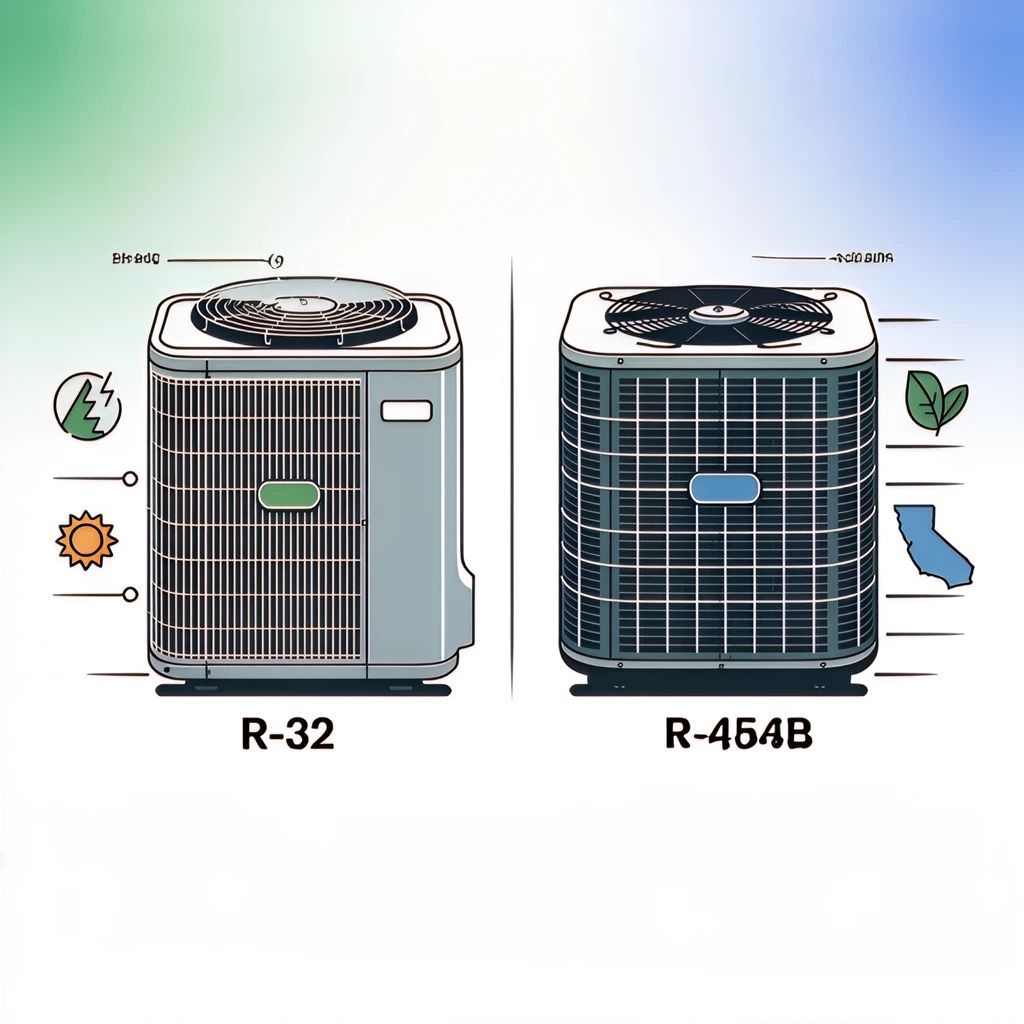
If you are replacing your air conditioner in California this year, two words will come up in every conversation with your HVAC contractor: R-32 and R-454B. These are the two new refrigerants replacing R-410A across all new residential systems as of January 1, 2026. Every unit your contractor installs today whether a central AC, a heat pump, or a ductless mini-split, uses one of them.
The problem? Most homeowners have no idea what either one means, which one their new system uses, or whether the difference matters. That confusion is understandable. Refrigerants are not something most people think about until the moment they are standing in a showroom or getting a replacement quote.
This guide gives you a clear, no-jargon breakdown of R-32 vs R-454B what each refrigerant is, how they compare in real terms, what the 2026 transition means for California homeowners specifically, and what questions to ask your contractor before you sign anything.
Why R-410A Is Gone and What Replaced It
For nearly 30 years, R-410A was the standard refrigerant in residential HVAC systems across the United States. It did its job well. The problem was its environmental footprint. R-410A has a Global Warming Potential of 2,088, meaning it traps over 2,000 times more heat in the atmosphere than carbon dioxide when released.
Under the EPA’s AIM Act (American Innovation and Manufacturing Act), the federal government mandated a phase-down of high-GWP refrigerants. The compliance deadline for new residential HVAC equipment was January 1, 2026. From that date forward, no new residential system with a GWP above 700 can be installed in the United States.
California went further. The California Air Resources Board has additional environmental compliance standards that align with and in some cases exceed federal requirements. For California homeowners, this transition is not optional or gradual; it is already here.
Both R-32 and R-454B meet the new GWP requirement. Both are classified as A2L refrigerants, a safety designation we will explain shortly. Both are already installed in hundreds of thousands of homes across Asia and Europe, where the transition happened years earlier. Neither is experimental.
What Is R-32?
R-32, also known as difluoromethane, is a single-component refrigerant. That means it is made of one chemical compound, not a blend. Brands like LG and Fujitsu have adopted R-32 as their refrigerant of choice.
Key facts about R-32:
- GWP of 675, roughly one-third the environmental impact of R-410A
- Single-component chemistry does not fractionate, which means a technician can top it off without replacing the entire charge
- 10 to 12 percent more energy-efficient than R-410A systems of the same size
- Widely proven used across Japan, Australia, and most of Europe since 2012
- Requires 20 to 30 percent less refrigerant by weight to achieve the same cooling output
- Easier to recycle single-component refrigerants are simpler to recover and reclaim after system decommissioning
The single-component nature of R-32 is a meaningful practical advantage. When a blended refrigerant leaks, the different chemicals escape at different rates, which changes the mixture left behind. A technician cannot simply top off a blended refrigerant the remaining charge must often be replaced entirely. R-32 does not have this problem.
What Is R-454B?
R-454B, sold under the trade name Puron Advance by Carrier, is a blended refrigerant made from R-32 and R-1234yf. Brands like Mitsubishi Electric, Bosch, and Carrier have adopted R-454B as their primary refrigerant.
Key facts about R-454B:
- GWP of approximately 466 slightly lower than R-32, making it the more climate-friendly option on paper
- Blended refrigerant a combination of two chemical compounds formulated to closely mimic R-410A operating pressures
- Easier manufacturer transition because it operates at pressures similar to R-410A, some manufacturers adapted existing equipment designs more easily
- Widely adopted by premium brands Mitsubishi Electric, one of the most trusted names in ductless systems, has standardised on R-454B
- Both components well-tested R-1234yf has been used in automotive air conditioning for years
The slightly lower GWP of R-454B is a genuine environmental advantage. In California, where regulatory standards around refrigerant emissions are among the strictest in the country, that distinction carries real weight.
R-32 vs R-454B Side-by-Side Comparison
| Feature | R-32 | R-454B |
|---|---|---|
| GWP (Global Warming Potential) | 675 | ~466 |
| Type | Single-component | Blended (R-32 + R-1234yf) |
| Safety Classification | A2L (mildly flammable) | A2L (mildly flammable) |
| Efficiency vs R-410A | Up to 12% improvement | Comparable improvement |
| Servicing Ease | Can be topped off | A full recharge may be needed after a leak |
| Brands Using It | LG, Fujitsu, Daikin | Mitsubishi, Carrier, Bosch |
| Industry Track Record | 12+ years globally | Newer, but backed by proven components |
| California Compliance | Yes, GWP is below 700 | Yes, GWP is below 700 |
| Leak Detection Required | Yes, mandatory on new systems | Yes, it’s mandatory on new systems |
| Can retrofit into R-410A system | No | No |
Both refrigerants pass California and federal compliance requirements. The right choice for your home depends on which brand and system your contractor recommends, not on chasing a lower GWP number.
What “A2L” Actually Means And Why It Is Not Something to Worry About
The classification “A2L” stops many California homeowners mid-conversation. “Mildly flammable” sounds alarming when someone is talking about a refrigerant running through your home’s walls and ceilings.
Here is the practical context. The “A” in A2L means low toxicity these refrigerants are not poisonous in the way older industrial refrigerants were. The “2L” means the refrigerant is technically capable of burning, but only under very specific and unlikely conditions: a high concentration of refrigerant in the air, a strong ignition source, and very limited airflow.
To put that in perspective, your gas stove, water heater, and the aerosol can in your bathroom cabinet all carry a higher real-world ignition risk than a properly installed A2L HVAC system. A2L refrigerants have been standard in residential systems across Japan and Europe since 2012 with an exceptional safety record.
Every new A2L system sold in the United States is required to include a built-in leak detection system (LDS). If the system detects refrigerant in the air, it shuts down automatically before concentrations can reach a hazardous level. This is a mandatory safety feature, not an optional upgrade. You do not pay extra for it comes standard.
California contractors installing A2L systems are required to hold current A2L certification. When you hire a licensed HVAC company, their technicians will have completed this training.
What This Transition Means for Your Existing R-410A System
One of the most common questions from California homeowners right now is whether they need to replace their current system immediately.
The short answer is ‘Not unless it needs replacing for other reasons.’
The EPA’s January 2026 deadline applies to new installations only. If your R-410A system is running well, you can continue using it and servicing it. R-410A refrigerant remains available for existing system maintenance.
However, two things have changed for homeowners with ageing R-410A systems:
R-410A prices have risen significantly. Production was cut by 40 percent and wholesale prices roughly doubled in 2025 and 2026 as manufacturers shifted to A2L production. If your system needs more than a pound or two of refrigerant, the repair cost may be substantially higher than it was two or three years ago.
R-410A will become harder to source over time. The phase-down continues through 2030. Supply will tighten further. Homeowners whose R-410 Systems that are 10 years old or older are in the zone where a repair vs. replacement conversation makes financial sense even if the system has not failed yet.
A practical rule of thumb: if your R-410A system needs a refrigerant refill and the repair estimate approaches $700 or more, comparing that cost against a new A2L system with California rebates and federal tax credits is worth doing before you commit.
California-Specific Considerations
California homeowners have advantages that homeowners in other states do not.
California rebate programmes: The California Public Utilities Commission and many utility companies, including PG&E, SCE, and SDG&E offer rebates on high-efficiency heat pumps and HVAC systems. These rebates stack with the federal 25C tax credit for qualifying systems.
TECH Clean California: This programme provides enhanced rebates specifically for switching from gas heating to electric heat pump systems. Households meeting income thresholds qualify for additional incentives.
Title 24 compliance: New California construction and major replacements must meet Title 24 energy efficiency standards. Any new system you install should be sized and rated to meet these standards. Your contractor is responsible for verifying compliance, but you should confirm it before signing a contract.
Hot climate performance: California’s Central Valley, Inland Empire, and Southern California regions regularly see temperatures above 100 degrees Fahrenheit. Both R-32 and R-454B perform reliably in these conditions, but proper system sizing for California’s climate zones is critical. An undersized system will run continuously and still fail to cool your home adequately on the hottest days.
What to Ask Your Contractor Before Signing
Before committing to any AC replacement in California in 2026, ask your contractor these specific questions:
- Which refrigerant does this system use, R-32 or R-454B? Either is acceptable. You are asking to understand what you are buying, not to reject one option.
- Is this system compliant with California Title 24 and EPA AIM Act requirements? A credible contractor will confirm this without hesitation.
- Does the system include a built-in leak detection system? All new A2L systems are required to have one. If a contractor is quoting a system without one, ask why.
- Are your technicians A2L certified? This certification is required for handling A2L refrigerants. Do not let an uncertified technician install or service an A2L system in your home.
- What California rebates and federal tax credits does this system qualify for? A knowledgeable contractor will know the current rebate landscape for your utility district.
- What SEER2 rating does this system carry? SEER2 replaced the old SEER rating in 2023. For federal tax credits, central AC systems need a minimum SEER2 of 17.0. Heat pumps need a minimum SEER2 of 15.2.
The Bottom Line for California Homeowners in 2026
The refrigerant transition is real, it is complete, and it is already delivering better, cleaner, more efficient HVAC systems to California homeowners. Whether your new system uses R-32 or R-454B will depend on the brand your contractor recommends, and both are excellent, proven, and California-compliant choices.
What matters more than the refrigerant label is working with a licensed, A2L-certified contractor who sizes the system correctly for your home and California climate zone, installs it to code, registers the warranty, and helps you access every rebate and tax credit available to you.
At Home Right Inc, we help California homeowners navigate these decisions with accurate, up-to-date information, from understanding the refrigerant transition to finding the right system for your home’s specific needs. If you are planning an AC replacement in 2026, explore our California HVAC resources or reach out directly for guidance tailored to your situation.
Ready to replace your AC the right way in 2026? Browse HomeRight Inc’s California HVAC guides to understand your rebate options, compare system types, and get answers before you talk to a contractor.
