

It’s the middle of July. The temperature outside is pushing 95°F, and the moment you walk through the front door you realize something is very wrong. Your air conditioner is running you can hear it but the house feels like a sauna. Before you pick up the phone and schedule a service call, take a breath. There’s a good chance a simple reset is all your system needs.
In over a decade of covering home systems and HVAC maintenance, we’ve seen this scenario play out hundreds of times. A reset doesn’t fix everything, but it fixes far more than most homeowners realize. Power fluctuations, brief electrical surges, sensor glitches, and minor thermostat errors are among the most common reasons an AC stops performing correctly, and a proper reset clears all of them in minutes.
This guide walks you through how to reset every type of air conditioner: central AC units, window units, and portable units. We’ll also cover what competitors miss: safety precautions, the 30-minute wait rule, when a reset is not enough, and the signs your AC may be heading toward a bigger problem.
Why Does an Air Conditioner Need to Be Reset?
Modern air conditioners are not purely mechanical systems. They rely on control boards, sensors, and protection circuits that monitor voltage, temperature, and operating pressure in real time. When something falls outside of normal parameters— a power outage, a surge from a lightning strike, a brownout, or even an unexpected spike from a large appliance cycling on — the unit’s protection circuit trips.
Think of it like your phone freezing up after running too many processes at once. The fix isn’t a hardware replacement; it’s a restart. Your AC’s protection circuit works the same way. It deliberately shuts the system down to prevent damage, and it won’t restart on its own until you manually clear the fault.
Here are the most common reasons you’ll need to reset your AC:
- Power outage or electrical surge — the most frequent trigger by far
- Brownout (low-voltage event) that caused the control board to fault
- Thermostat error or communication failure between the thermostat and the air handler
- Sensor malfunction inside the unit (temperature or pressure sensor)
- Unit short-cycling (turning on and off rapidly) that triggered a safety lockout
- Incorrect settings after a thermostat battery replacement
Important safety note: If your AC trips its breaker repeatedly meaning it keeps shutting off even after you reset it that is not a minor glitch. Repeated tripping indicates a deeper electrical or mechanical problem. Stop resetting it and call a licensed HVAC technician. Continuing to reset a unit with an underlying fault can cause compressor failure, which is one of the most expensive repairs in residential HVAC.
Before You Reset: Safety Precautions
No guide on resetting an air conditioner is complete without safety precautions. Working near electrical panels and outdoor condenser units involves real risk. Follow these steps before you do anything else:
- Turn your thermostat to OFF not just to a higher temperature, but completely off. This prevents the unit from trying to cycle while you’re working.
- Let the unit rest for at least 15–30 minutes if it was running recently. Compressors need time to equalize pressure before a restart attempt. Forcing a cold start too quickly can damage the compressor.
- Wear rubber-soled shoes if you’re going near the electrical panel.
- Do not attempt to open any panel on the outdoor condenser unit or the air handler. The reset button and isolation switch are externally accessible you do not need to open the unit.
- Check your warranty documentation before proceeding. Tampering with internal components can void your warranty. A button press or breaker flip will not — but know the line.
- If you have any doubt about what you’re doing, stop and call a professional. A service call is far cheaper than a mistake near high-voltage equipment.
Where Is the AC Reset Button? (And What If There Isn’t One?)
One of the most common questions homeowners ask is where to find the reset button on their air conditioner. The answer depends on the type of unit and here’s what most guides fail to tell you: not all air conditioners have a dedicated reset button.
Central Air Conditioners
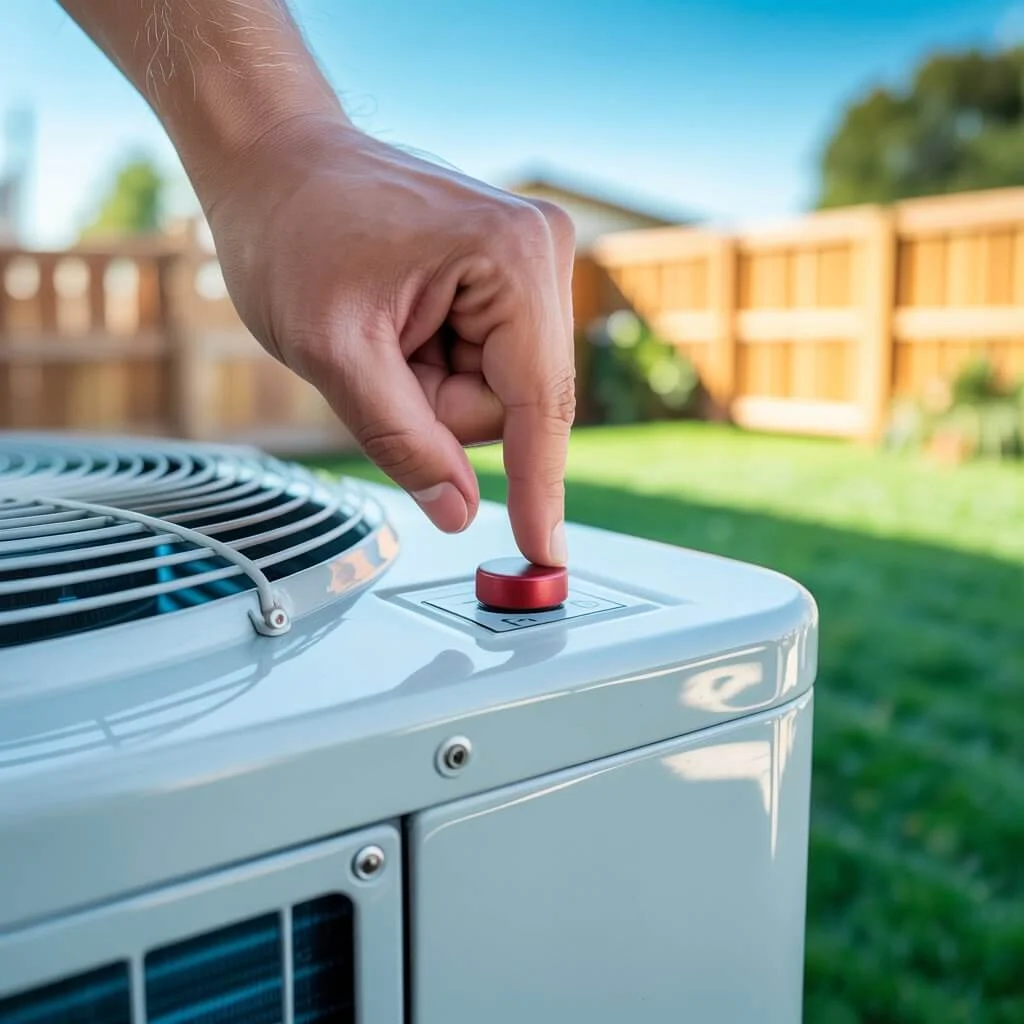
On central AC systems, the reset button is typically a small red or yellow button located on the outdoor condensing unit, often near the bottom edge or behind a small access panel labeled ‘Reset.’ Some models position it near the refrigerant lines. If you can’t locate it visually, check your unit’s owner manual or search the model number online.
Window Air Conditioners
On window units, the reset button is usually found on the control panel or where the power cord connects to the base of the unit. It’s often built into the GFCI plug on newer models (look for the ‘Test’ and ‘Reset’ buttons on the plug itself). If your window unit doesn’t have a reset button at all, unplugging it for 5–10 minutes accomplishes the same thing.
Portable Air Conditioners
Portable units typically have a reset button on the control panel or on the back of the unit. If there’s no button, unplug the unit from the wall and leave it unplugged for at least 5 minutes.
What If I Can’t Find the Reset Button?
Don’t worry every AC can be reset even without a dedicated button. The circuit breaker reset method works for all central systems, and the unplug method works for all window and portable units. The reset button is simply a convenience, not a requirement.
How to Reset a Central Air Conditioner (Step-by-Step)
Central AC systems have three primary reset methods. We recommend trying them in this order:
Method 1: Reset Using the Reset Button
This is the cleanest and most direct method when the button is accessible.
- Set your thermostat to OFF.
- Go to your home’s electrical panel and switch the breaker for the HVAC or air conditioner to the OFF position.
- Walk to the outdoor condensing unit and locate the reset button (small, red or yellow).
- Press and hold the reset button for 3 to 5 seconds, then release.
- Return to the electrical panel and flip the HVAC breaker back to ON.
- Wait 5 minutes before turning the thermostat back to COOL and setting it 5°F below the current indoor temperature.
- Listen for the unit to cycle on and check that cool air is flowing from the vents within a few minutes.
Method 2: Reset via the Circuit Breaker (No Reset Button Needed)
This method works for all central AC systems, with or without a reset button.
- Set your thermostat to OFF.
- Locate your home’s electrical panel commonly in the garage, basement, utility closet, or hallway.
- Find the breaker labeled for your HVAC, air conditioner, or AC unit. (On some panels it may say ‘air handler’ and ‘condenser’ as two separate breakers flip both.)
- Switch the breaker to the OFF position.
- Wait a full 30 minutes. This is the step most guides rush. The 30-minute window allows the compressor’s internal pressure to fully equalize, which is essential for a safe, successful restart.
- Flip the breaker back to ON.
- Wait another 5 minutes, then set the thermostat back to COOL.
Method 3: Use the Isolation Switch
Many outdoor condensing units have a disconnect box or isolation switch mounted on the exterior wall nearby usually a gray or beige box within a few feet of the unit. This gives you a way to cut power to the outdoor unit independently of your main panel.
- Set your thermostat to OFF.
- Open the disconnect box and pull out the disconnect block (a plug-style piece that disconnects the circuit) or turn the isolation switch to OFF.
- Wait 30 to 60 minutes.
- Restore the disconnect block or turn the switch back to ON.
- Wait 5 minutes before setting the thermostat to COOL.
Method 4: Unplug the Unit (If Applicable)
Some smaller central systems and mini-split units can be fully unplugged. Locate the shutoff panel near the outdoor unit, cut power to the compressor, then unplug the unit from its power source. Leave it unplugged for at least 30 minutes to allow residual charge to dissipate from the control board. Plug back in, restore power, and wait 5 minutes before turning on.
How to Reset a Window or Portable Air Conditioner
Window and portable ACs are simpler to reset than central systems because they run at lower voltages and don’t have the compressor pressure equalization concerns of larger units.
Window AC Reset (With Reset Button)
- Turn the unit OFF using its controls.
- Press and hold the reset button on the unit or on the GFCI plug for 3 to 5 seconds until you feel a click or see an indicator light respond.
- Plug back in (or press ‘Reset’ on the GFCI outlet) and power the unit back on.
Window AC Reset (Without Reset Button)
- Turn the unit OFF.
- Unplug the unit from the wall outlet.
- Wait 5 to 10 minutes.
- Plug back in and power on.
If the outlet itself is GFCI-protected (look for the unit’s location relative to any bathroom, kitchen, or outdoor outlet), try pressing the ‘Test’ button on the outlet and then the ‘Reset’ button to restore power to the outlet before plugging the AC back in.
Portable AC Reset
- Turn the unit off and unplug it.
- Wait 5 to 10 minutes for internal components to reset.
- Plug back in, power on, and monitor performance.
Always drain the portable unit’s condensate tank before restarting if it has been sitting unused, as a full tank can trigger an automatic shutoff on most models.
How to Reset the AC Compressor
The AC compressor is the heart of your cooling system. It pressurizes the refrigerant and drives the entire cooling cycle. When the compressor overheats or experiences a fault, it may lock out and a simple thermostat or button reset won’t clear it.
Here’s what most guides don’t tell you: compressors have a built-in thermal overload protection switch. When the compressor overheats, this internal switch trips and the compressor will not restart even after a breaker reset until it has cooled down. This is why the 30-minute wait after a breaker reset is not optional. It gives the compressor time to cool and allows the thermal overload to automatically reset.
To reset the AC compressor:
- Turn the thermostat to OFF.
- Switch the AC breaker to OFF at the electrical panel.
- Wait a minimum of 30 minutes — longer if the outdoor temperature is above 90°F or the unit was running hard.
- Turn the breaker back ON.
- Wait 5 additional minutes before turning the thermostat to COOL.
If the compressor still does not start after this process, you may hear a clicking or humming noise from the outdoor unit. This can indicate a failed start capacitor a relatively common and affordable repair — but one that requires a licensed technician.
Don’t Forget the Thermostat: A Common Reset Homeowners Skip
One reset step that competitors frequently overlook: your thermostat itself may need a reset, independently from the AC unit. If your system was blowing warm air before you started troubleshooting, the thermostat is sometimes the culprit — not the AC at all.
How to Reset a Digital or Smart Thermostat
- Many digital thermostats have a small reset pinhole on the face. Use a paperclip to press and hold it for 5 seconds.
- For Nest, Ecobee, and other smart thermostats, go to Settings > Reset > Schedule and Settings, or hold down the thermostat button for 10 seconds until it restarts.
- After any thermostat reset, re-enter your temperature schedule and confirm the system mode is set to COOL (not AUTO or HEAT).
Check the Thermostat Batteries
This is one of the most overlooked causes of AC failure. Low thermostat batteries can cause erratic behavior, missed calls to the AC, or a completely blank screen. Replace batteries at least once a year and always check them before assuming there’s a problem with the AC unit itself.
After the Reset: What to Check and How Long to Wait
A successful reset doesn’t mean your AC will cool instantly. Here’s what to expect and look for:
- The outdoor unit should start within 1 to 5 minutes of turning the thermostat to COOL. If it doesn’t start within 10 minutes, there’s likely an underlying issue.
- Place your hand over a central air vent after 10 to 15 minutes. You should feel noticeably cool air not just slightly cooler than room temperature.
- The indoor temperature should begin to drop within 20 to 30 minutes in a well-sealed home. On extremely hot days (above 95°F), it may take longer.
- Listen for any unusual sounds: grinding, banging, hissing, or rapid clicking. These are red flags that something mechanical is wrong and the AC needs professional attention.
- Check all vents are open and unobstructed. Closed vents can cause pressure imbalances that affect cooling performance.
- Check or replace the air filter. A clogged filter is one of the top reasons ACs underperform. Most filters should be replaced every 30–90 days depending on usage and household conditions.
When Resetting Your AC Won’t Help (And What Will)
A reset is a diagnostic step not a cure-all. If any of the following symptoms are present, stop resetting and call a professional:
- The breaker trips again within minutes of a reset (indicates electrical fault — wiring, capacitor, or compressor issue)
- You hear hissing, bubbling, or gurgling sounds from the indoor unit or refrigerant lines (refrigerant leak)
- Ice or frost is forming on the refrigerant lines or indoor coils (frozen evaporator — often caused by airflow restriction or low refrigerant)
- The outdoor unit’s fan is not spinning even though the unit has power (failed capacitor or fan motor)
- You smell burning plastic or a chemical odor (electrical issue — turn off immediately)
- The AC works for a few minutes then shuts off repeatedly (short-cycling can destroy a compressor over time)
- Energy bills have spiked significantly with no change in usage habits (system working too hard due to refrigerant loss or failing components)
These symptoms require hands-on diagnostics from a licensed HVAC technician with proper tools and certifications. Resetting a unit with these underlying problems not only won’t fix anything — it can make the damage worse.
How to Prevent Your AC From Needing Frequent Resets
If you find yourself resetting your AC multiple times per season, something is wrong. A properly maintained air conditioner should rarely need a reset outside of a major power event. Here’s what you can do to reduce the likelihood:
Change filters regularly: A dirty filter restricts airflow, causing the evaporator coil to freeze and the system to work harder. Check monthly, replace every 1–3 months.
Annual professional tune-up: A licensed HVAC technician should inspect and service your system once a year ideally in spring before cooling season. They’ll check refrigerant levels, clean coils, test electrical connections, and inspect the capacitor.
Keep the outdoor unit clear: Maintain at least 2 feet of clearance around the condenser unit. Clear away leaves, grass clippings, and debris from the unit’s fins regularly.
Install a surge protector: A whole-home surge protector ($150–$300 installed) protects your HVAC system and every other major appliance from voltage spikes that trigger protection circuits.
Check refrigerant every 2–3 years: Refrigerant doesn’t ‘run out’ on its own, but leaks are common in older systems. Low refrigerant causes the system to overwork, leading to repeated faults and resets.
Clean the condensate drain annually: A clogged condensate drain can trigger a float switch that shuts the system off — which looks exactly like an AC failure but isn’t one.
Final Thoughts
Resetting your air conditioner is one of the simplest and most effective DIY troubleshooting steps a homeowner can take. In many cases, a 30-minute breaker reset is the difference between a $0 fix and an unnecessary service call. But it’s also important to know when to stop and call a professional when the breaker keeps tripping, when unusual sounds or smells are present, or when the system refuses to hold a reset.
The key takeaways from this guide: always wait the full 30 minutes before restarting, check your thermostat batteries before assuming the AC is the problem, and schedule an annual tune-up to avoid most of these issues in the first place.
At HomeRightInc, we believe informed homeowners make better decisions and spend less money doing it. If you found this guide helpful, explore our full library of home maintenance and HVAC guides for everything from changing air filters to understanding SEER ratings on new AC systems.
