

Most people who launch a heating and air conditioning business already know the technical side. They’ve spent years under crawlspace floors, on rooftops in August heat, and in mechanical rooms troubleshooting equipment that refuses to cooperate. What surprises them is that running the business itself is a completely different skill set one that nobody hands you a manual for.
This guide is that manual. Whether you’re a licensed technician ready to go solo, or someone brand new researching this industry as a business opportunity, you’ll find everything here that actually matters when building a heating and air conditioning business that lasts. We’ve studied what the top guides online cover and more importantly, what they skip. The gaps are real, and we’re filling them.
What Does a Heating and Air Conditioning Business Actually Do?
Before anything else, get clear on the scope of this industry. A heating and air conditioning business installs, repairs, and maintains the systems that control temperature and air quality inside buildings. That covers residential homes, commercial properties, and industrial facilities.
The core service categories most contractors offer include:
- System installation: new construction and replacement of existing equipment
- Repair and diagnostics: troubleshooting failures, replacing components, emergency calls
- Preventive maintenance: seasonal tune-ups, filter changes, efficiency checks
- Indoor air quality (IAQ): air purifiers, humidifiers, ventilation improvements
- Energy efficiency upgrades: smart thermostats, zoning systems, heat pump conversions
- Commercial HVAC : rooftop units, chillers, larger commercial systems
The industry is shifting rapidly in 2026. Heat pump technology, which serves both heating and cooling functions, has moved from niche to mainstream as energy prices climb and federal efficiency incentives remain in play. Any new heating and air conditioning business should understand heat pump installation and servicing, because that’s where significant market growth is happening right now.
Indoor air quality has also become a genuine revenue driver. Post-pandemic awareness around air filtration and ventilation has stuck with homeowners and commercial building managers alike. Offering IAQ services isn’t optional anymore; it’s a differentiator that separates serious operators from shops that only replace capacitors.
Is a Heating and Air Conditioning Business Worth Starting in 2026?
The honest answer: yes, but only if you go in prepared. This isn’t a business you can bootstrap on a credit card and figure out as you go. Equipment is expensive. Licensing takes time. Competition from established local companies is real. But for operators who take it seriously from day one, the financial ceiling is genuinely high.
Here’s what the numbers look like at different stages:
| Stage | Annual Revenue Potential |
| Solo operator, first year | $80,000 – $150,000 |
| 2-3 technician team | $400,000 – $700,000 |
| 5+ truck operation | $1M – $3M+ |
| Commercial-focused company | $2M – $10M+ |
Profit margins in a well-managed heating and air conditioning business typically run 8–15% net, with top performers pushing 20%+ through service agreements and premium pricing on parts. Those margins require disciplined job costing, efficient routing, and a pricing structure built on real cost data not guesswork.
| Pro Insight: The contractors who struggle financially are almost never failing because they can’t do the work. They’re failing because they priced jobs based on what competitors charge rather than what their own costs require. Know your numbers before you quote a single job. |
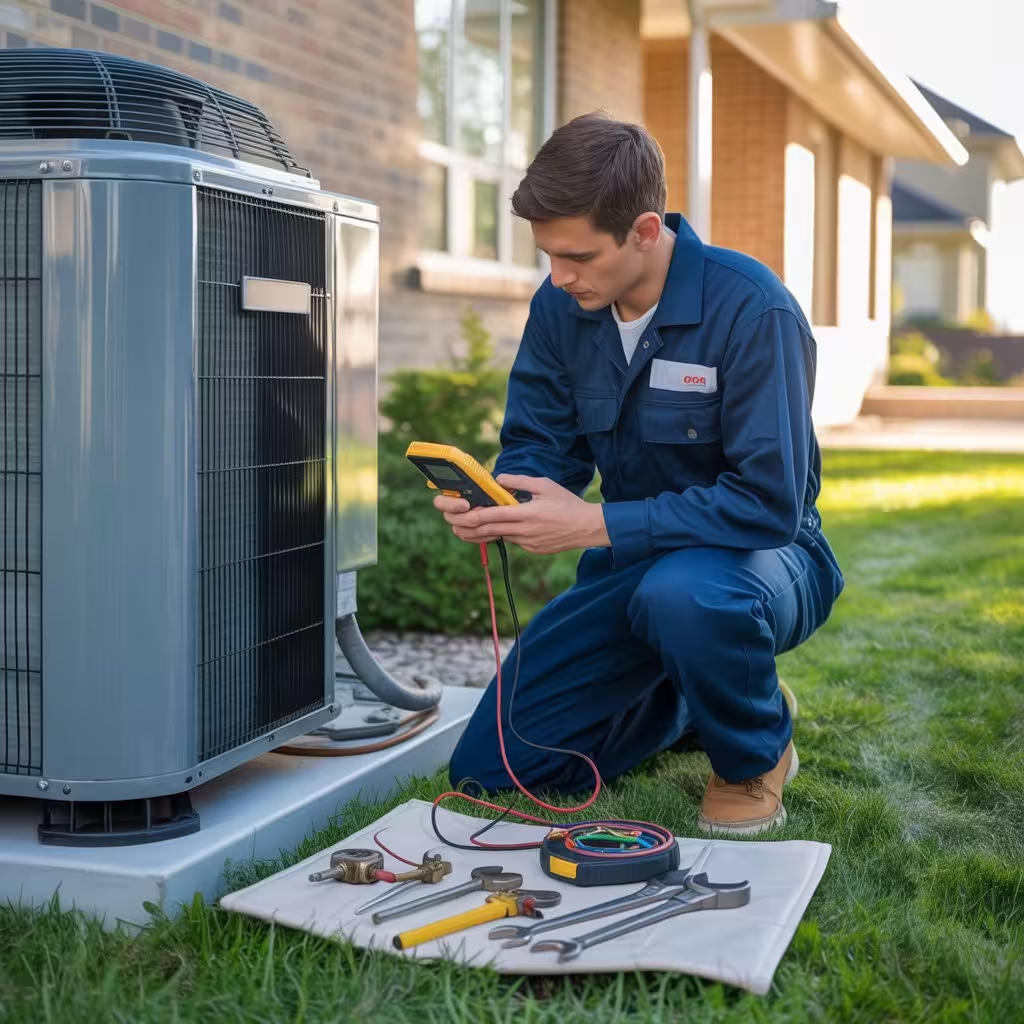
Step 1: Get Licensed and Certified the Right Way
Licensing for a heating and air conditioning business is non-negotiable, and it’s more layered than most guides admit. You’re dealing with state contractor licenses, local municipality permits, EPA certification for refrigerants, and optional industry certifications that carry serious weight with customers.
State Contractor Licenses
Licensing requirements vary dramatically by state. Some, like California, Florida, and Texas, have robust licensing infrastructure with written exams, experience hour requirements, and financial statement reviews. Others are looser. Here’s a general breakdown of what most states require:
- Journeyman license: typically requires 2–4 years of supervised experience and a written exam
- Master or Class A contractor license: requires additional experience (often 5+ years) and business exam components
- Refrigeration endorsement:some states require this separately for working with refrigerants
- Specialty licenses:solar-assisted HVAC, commercial refrigeration, or boiler work may need separate licensing
The “$500 rule” or “$1,000 rule” you’ll hear about refers to the threshold below which some states allow unlicensed work. But for anyone building a real heating and air conditioning business, you’ll be crossing those thresholds constantly. Get licensed before you take your first paid job.
EPA Section 608 Certification
If you’re working with refrigerants, and you will be federal law requires EPA Section 608 certification. There are four types: Type I (small appliances), Type II (high-pressure systems), Type III (low-pressure systems), and Universal. For a full-service heating and air conditioning business, get Universal. It costs roughly $20–$30 to test and covers everything.
NATE Certification
North American Technician Excellence (NATE) certification isn’t legally required, but it’s one of the strongest trust signals you can show residential customers. Third-party validated, nationally recognized, and prominently featured by major manufacturers like Carrier and Trane NATE certification on your website and truck windows tells homeowners you’ve been tested, not just trained.
| What competitors miss: Most guides tell you to “get licensed” without explaining that your city or county may have additional permit requirements on top of your state license. Always call your local building department before starting operations. This step alone prevents costly violations. |
Step 2: Write a Business Plan That Actually Works
A business plan isn’t a document you write to impress a banker and then forget. For a heating and air conditioning business, it’s the architecture that keeps every decision connected to a larger strategy. The contractors who skip this step spend years making reactive decisions instead of proactive ones.
Your business plan should answer six core questions:
- What specific services will you offer, and what won’t you touch (at least initially)?
- Who is your target customer — residential homeowners, property managers, commercial clients, or a mix?
- What geographic territory will you serve, and when will you expand?
- How will customers find you, and what will it cost to acquire each one?
- What are your realistic startup costs, and how long until you’re cash-flow positive?
- What does your operation look like at Year 1, Year 3, and Year 5?
Choosing Your Business Model
This is a decision most startup guides gloss over, but it shapes everything from equipment purchases to hiring timelines. You have three primary models:
Most successful heating and air conditioning businesses start residential and add commercial capacity as they build a track record. Commercial clients want to see experience before they hand over their HVAC systems
Step 3: Understand Your Real Startup Costs
This is where most startup guides fail the reader. They cite a wide range like “$10,000 to $50,000” without breaking down what those dollars actually buy. Let’s fix that.
| Expense Category | Realistic Cost Range |
| HVAC tools and hand tools | $3,000 – $8,000 |
| Diagnostic and specialized equipment | $5,000 – $15,000 |
| Service vehicle (used) | $8,000 – $25,000 |
| Vehicle branding/wrap | $1,500 – $4,000 |
| Initial parts and refrigerant inventory | $2,000 – $6,000 |
| Licensing and certification fees | $500 – $2,500 |
| Business registration and legal | $300 – $1,500 |
| Insurance (first year) | $3,000 – $8,000 |
| Website and initial marketing | $1,500 – $5,000 |
| Software (field service management) | $100 – $300/month |
| Working capital buffer (3 months) | $10,000 – $20,000 |
| TOTAL ESTIMATE | $35,000 – $95,000 |
That working capital buffer deserves special attention. Your first three months in a heating and air conditioning business will involve expenses before revenue catches up. Slow invoice payments, slower-than-expected lead volume, and unexpected equipment costs are all normal. Going in undercapitalized is one of the most common reasons new HVAC businesses fail, not a lack of technical skill.
Funding Your Heating and Air Conditioning Business
- Personal savings: no debt, no interest, but limits your runway and can put personal finances at risk
- SBA 7(a) loans: lower interest rates, longer terms, excellent for equipment and working capital; requires solid credit and a business plan
- Equipment financing: spreads the cost of trucks and major diagnostic tools; keeps cash liquid for operations
- Local bank or credit union loans: often more flexible than national banks for trade businesses with local roots
- Manufacturer financing: some HVAC equipment manufacturers offer dealer financing programs worth exploring
Step 4: Register Your Business and Build the Legal Foundation
After choosing your structure, you’ll need an EIN (Employer Identification Number) from the IRS, which is free and available online in minutes; a business bank account opened in the company’s name; a business credit card for separating and tracking company expenses; and any local business licenses or permits required by your city or county.
Your business name matters more than people think. It appears on your truck, your website, your uniforms, and every review ever written about you. Choose something that’s easy to spell, easy to say, reflects professionalism, and is available as a .com domain and across social media handles.
Step 5: Build Your Tool Kit and Set Up Your Service Vehicle
Your service truck is a rolling storefront. How it’s organized, what it carries, and how it looks tells customers everything about how you run your business before you say a word. Getting this right from day one matters.
Essential Tools for a New HVAC Business
- Digital manifold gauge set (Bluetooth-enabled for documentation and diagnostics)
- Refrigerant recovery machine and certified recovery tank
- Vacuum pump (at least 6 CFM for residential work)
- Digital multimeter and clamp meter
- Combustion analyzer for gas furnace work
- Thermal imaging camera a game-changer for diagnostics customers can see
- Refrigerant scale and refrigerant identifier
- Drill/driver set, hole saws, sheet metal snips, tin snips
- Pipe cutters, flaring tools, swaging tools
- Safety equipment: gloves, goggles, fall protection, respirator.
Truck Stock: What to Carry
Experienced HVAC contractors will tell you that same-day diagnosis and repair is the fastest way to build a reputation and maximize revenue per call. That means carrying the parts that fail most often. Your truck stock should include:
- Capacitors in common microfarad ratings (most failures in residential AC are capacitors)
- Contactor sets for common tonnage equipment
- Common filter sizes for maintenance calls
- Refrigerant (most common types in your market)
- Fuses, breakers, disconnect blocks in common sizes
- Thermostat — at least one universal smart thermostat for upgrades
- Miscellaneous fittings, wire, electrical tape, and sheet metal screws
Step 6: Build a Pricing Structure That Pays You What You’re Worth
Pricing is where good technicians become struggling business owners. The instinct to price low to win jobs is understandable but it’s financially dangerous. Your prices need to cover labor, parts, overhead, vehicle costs, insurance, marketing, and a profit margin that justifies the risk of running a business.
Calculate Your True Hourly Cost
Start with your annual overhead costs vehicle payments, insurance, licensing fees, software, marketing, phone, tools and divide by your billable hours per year. A solo operator working 48 weeks at 6 billable hours per day has roughly 1,440 billable hours. If your annual overhead is $72,000, your break-even rate is $50/hour before paying yourself a single dollar.
Add your desired salary, a profit margin for reinvestment and emergencies, and you have your minimum viable hourly rate. Most residential HVAC markets in 2026 support $90–$150+ per hour for skilled technicians. If your market is lower than your break-even, you have a problem that more jobs won’t fix.
Flat Rate vs. Time and Materials
Flat-rate pricing is the standard for residential HVAC service calls, and for good reason. It eliminates pricing disputes, rewards efficient technicians, and makes your revenue more predictable. With flat-rate pricing, you build a price book that assigns a fixed price to every service a capacitor replacement, a refrigerant recharge, a diagnostic fee.
Time-and-materials pricing still makes sense for complex commercial work, major retrofits, and new construction where scope is genuinely uncertain. Many successful heating and air conditioning business owners use flat-rate for service and a more detailed labor-plus-materials approach for installation.
Service Agreements: Your Recurring Revenue Engine
This is one of the most important revenue strategies that competitor guides barely mention. A maintenance agreement where customers pay $150–$300 per year for two seasonal tune-ups does three things simultaneously: it locks in recurring revenue, it keeps you in front of customers when their equipment ages, and it gives you priority scheduling rights that fill your calendar in slow seasons.
Even 50 maintenance agreements in your first year generates $7,500–$15,000 in predictable annual revenue before you take a single service call. Build this into your sales process from your first month.
Step 7: Get the Right Insurance Coverage
A single uninsured incident a technician’s error that causes a house fire, a van accident, a customer who slips on equipment left in their driveway can end a heating and air conditioning business before it finds its footing. Insurance is not optional.
| Coverage Type | What It Covers and Why It Matters |
| General Liability | Property damage and bodily injury caused during jobs. Required for most licensing and commercial contracts. Budget $1,500–$4,000/year. |
| Workers’ Compensation | Medical costs and lost wages if employees are injured on the job. Mandatory in most states the moment you hire your first employee. |
| Commercial Auto | Damage to vehicles and liability for accidents while driving for work. Personal auto policies don’t cover commercial use. |
| Tools and Equipment | Theft or damage to your tools and diagnostic equipment. Often surprisingly affordable — $300–$600/year. |
| Professional Liability | Covers claims that your advice or work caused financial loss. Increasingly important for energy efficiency consulting work. |
Work with an insurance broker who specializes in contractor businesses. They understand the specific risks of HVAC work and can bundle policies for better pricing than going to a general insurer.
Step 8: Set Up Financial Systems That Keep You Out of Trouble
More heating and air conditioning businesses struggle because of poor financial management than poor technical skills. Cash flow problems, unpaid invoices, missed tax obligations, and vague profit margins are common. Clean systems prevent all of them.
The Non-Negotiables from Day One
- Separate business checking account never mix personal and business money
- Business credit card track every expense, build business credit
- Accounting software QuickBooks or similar; even a solo operator needs clean books
- Invoice immediately same day as job completion, every time
- Track accounts receivable weekly chase overdue invoices before they become 90-day problems
- Set aside 25–30% of revenue for taxes quarterly estimated taxes are required; missing them is expensive
Managing Seasonal Cash Flow
This is something almost no startup guide addresses directly, but it’s one of the most challenging realities of a heating and air conditioning business. Revenue is not evenly distributed across twelve months. In most markets, you’ll have a high summer (AC work), a moderate fall heating startup rush, a slow November-February period, and a spring surge before summer.
Build a 12-month cash flow projection before you open. Know which months will be lean. Use those lean months for maintenance agreement renewals, commercial bidding, and training. Build a cash reserve during peak months to cover the valleys. Contractors who don’t plan for seasonality end up taking on debt just to cover operating costs in January.
Step 9: Build a Marketing Strategy That Generates Real Leads
Marketing a heating and air conditioning business in 2026 means being visible in multiple places simultaneously because customers don’t find service companies in one place anymore. They search Google, read reviews, scroll through neighborhood Facebook groups, and ask their real estate agent who they use.
Your Google Presence: The Foundation
Claim and fully complete your Google Business Profile before you take your first call. This is the single most valuable free marketing asset you have. Fill every field services, hours, service areas, photos of your truck, certifications, and a compelling description. Your GBP listing is what appears in the map pack when someone searches “AC repair near me” or “furnace service [your city].”
Encourage every satisfied customer to leave a Google review, and respond to every review positive or negative within 24 hours. Review velocity matters for local search ranking. Five new reviews per month outperforms one hundred reviews that stopped coming in two years ago.
Your Website: More Than a Business Card
A basic website isn’t enough in a competitive HVAC market. You need a site that loads fast on mobile, clearly states your services and service area, shows your certifications and insurance, features real customer reviews, has a phone number visible without scrolling, and offers an online booking or quote request option.
Invest in location-specific service pages not just a generic “HVAC Services” page, but individual pages for “AC Repair in [Your City],” “Furnace Installation in [Nearby Town],” and so on. This is how you capture local search traffic from every community in your service area.
Google Local Services Ads
Google Local Services Ads (LSAs) place your business above regular search results with a “Google Guaranteed” badge. You only pay per qualified lead, not per click. For a new heating and air conditioning business without established organic search rankings, LSAs can generate real leads within days of launch. Budget $500–$2,000 per month depending on your market’s competitiveness.
Building Referral Networks
The referral channels that most HVAC marketing guides overlook are the ones that generate the highest-quality leads with zero ad spend. Build relationships with:
- Real estate agents : they need HVAC companies for buyer inspections, seller repairs, and move-in emergencies
- Property management companies : one relationship can mean dozens of recurring service calls
- Plumbers, electricians, and roofers : trade referrals flow in all directions when you have trusted relationships
- Home warranty companies : getting on their preferred vendor list provides a steady stream of dispatched work
- New home builders :even one builder relationship can fill your calendar for an entire season
Step 10: Build a Technology Stack That Scales With You
This is the section competitors almost entirely skip, and it’s a serious gap. The heating and air conditioning businesses that scale efficiently in 2026 are the ones using technology to eliminate the administrative burden that otherwise consumes evenings and weekends.
The 2026 advantage: AI-assisted dispatching and route optimization tools now make it possible for a solo operator or small team to handle significantly more calls per day without additional hires. Look for field service software with smart scheduling features — the ROI is measurable within the first month. Step 11: Know When and How to Hire Your First Technician
The question isn’t whether to hire — it’s when. Most solo operators hit a ceiling around $120,000–$150,000 in annual revenue where there simply aren’t enough hours in the day to take more calls. That’s your hiring signal.
The Solo-to-Scale Roadmap
Milestone Action $80K–$120K annual revenue Start documenting your processes — how you diagnose, how you quote, how you handle callbacks $120K–$150K revenue + waitlist Hire your first technician or apprentice 2 trucks running consistently Hire office support or implement call center software $500K+ revenue Dedicated dispatch, structured marketing budget, service agreement coordinator When hiring, prioritize work ethic and customer skills alongside technical ability. A technically mediocre tech who shows up on time, communicates well, and leaves a clean job site will outperform a brilliant technician who’s abrasive and unreliable from a customer retention standpoint.
Verify certifications, run background checks, and check references from previous employers not just the names candidates give you. Call the company directly. And be realistic about compensation: competitive HVAC technician wages in 2026 range from $25–$45/hour depending on experience and market, plus benefits.
The First 90 Days: What to Focus On
This is the section competitors don’t write, but it’s what every new operator actually needs. The first 90 days of a heating and air conditioning business are about building the foundations that determine whether you’re still in business in Year 2.
Days 1–30 Complete licensing, register LLC, open business accounts, claim Google Business Profile, buy core tools and stock the truck, take any job you can to build reviews Days 31–60 Launch your website, set up field service software, introduce maintenance agreement to every customer, start building referral relationships with one plumber and one real estate agent Days 61–90 Analyze your job costs — are you making money on every type of job? Adjust pricing if needed. Start social media posting. Ask your best 10 customers for a Google review. Evaluate if you need additional financing. The goal at 90 days is not to have everything figured out. It’s to know what’s working, what isn’t, and what one change would have the most impact. The contractors who grow fastest in Year 1 are honest with themselves about those answers. Growing Your Heating and Air Conditioning Business Beyond Year One
Sustainable growth in the HVAC industry doesn’t come from simply taking more calls. It comes from systematizing your operations so each call generates more revenue, each customer stays longer, and each new technician you add makes you more profitable rather than just busier.
- Expand your service menu strategically : add duct cleaning, IAQ, heat pump conversions, or commercial service based on what your existing customers are already asking for
- Build a strong online reputation : one additional star in your average Google rating measurably increases your conversion rate from search to booked job
- Create a maintenance agreement program with an annual renewal incentive : customers who renew for year two are the most profitable customers you have
- Track your key metrics monthly: average ticket, cost per lead, conversion rate, revenue per technician, gross margin per service type
- Invest in ongoing training : manufacturer certification classes, NATE continuing education, and business management courses all pay dividends
The heating and air conditioning business owners who build companies worth millions aren’t necessarily the most technically skilled technicians. They’re the ones who took their skills seriously, treated the business as a system, and made consistent decisions based on real data rather than gut feel.
Final Thoughts: Building a Heating and Air Conditioning Business That Lasts
Starting a heating and air conditioning business is one of the most concrete paths to financial independence available in the skilled trades. The demand is real, the margins are achievable, and the barriers to entry —licensing, capital, expertise are high enough to keep competition from being overwhelming if you execute well.
But execution is everything. The contractors who succeed aren’t just better at HVAC they’re better at running a business. They price correctly, track their money, invest in marketing before they desperately need it, hire before they’re overwhelmed, and treat every customer like the beginning of a long-term relationship rather than a one-time transaction.
Use this guide as a working document, not a checklist you complete and file away. Revisit it as your heating and air conditioning business grows, and you’ll find different sections becoming relevant at different stages. The fundamentals don’t change only the scale does.
