
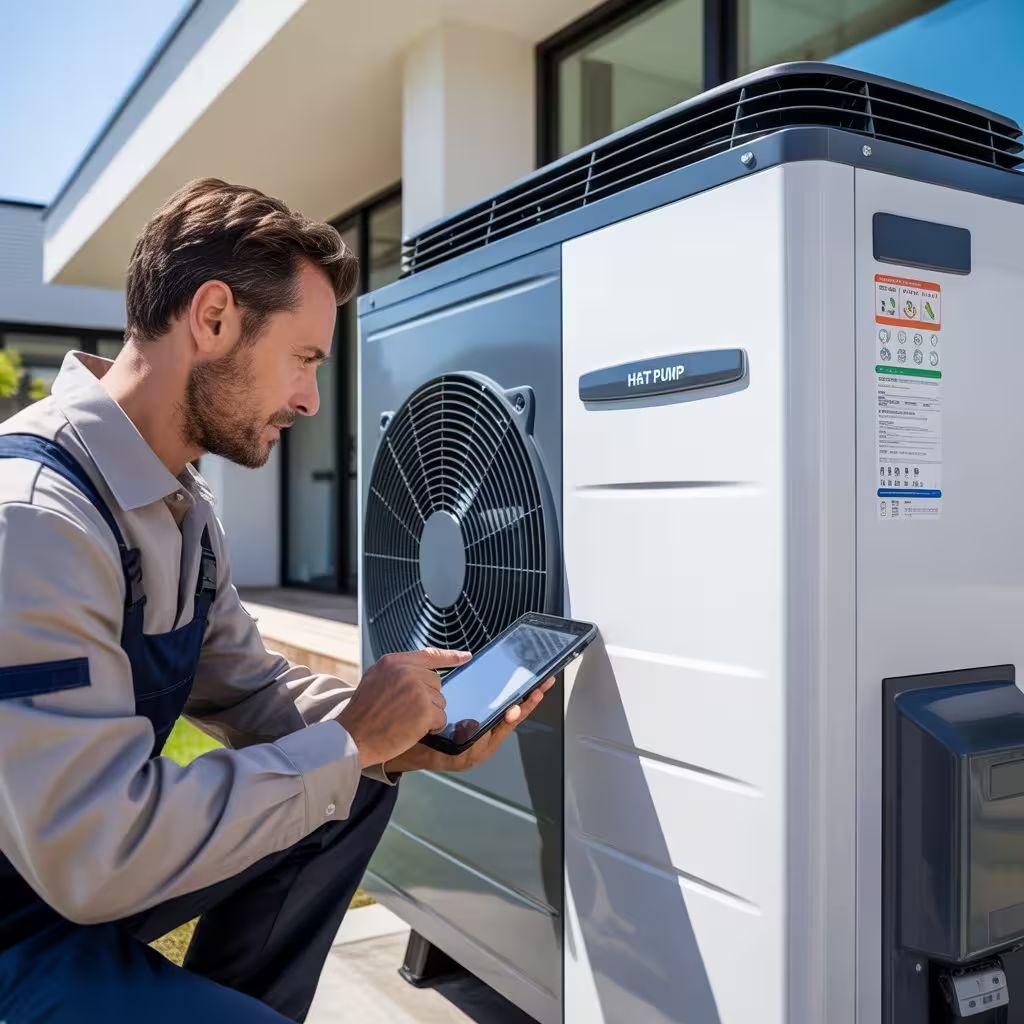
When your air conditioner dies in the middle of August or your furnace quits on the coldest night of January the last thing you want to be doing is reading the fine print on a warranty contract you barely remember signing. The debate between a home warranty vs. an HVAC maintenance plan is one that most homeowners never settle until a breakdown forces their hand. And by that point, the decision is already made for them, often at a steep cost.
This guide cuts through the marketing language that warranty companies and HVAC contractors both like to use and puts the real numbers in front of you. We’ll look at what each option actually covers, where each one falls short, what they cost over a five-year window, and critically, which combination of the two protects the typical homeowner without wasting money on overlapping coverage.
The answer isn’t always the same for every household. But there is a framework for making the right call, and by the end of this article, you’ll have it.
What Is an HVAC Maintenance Plan? (And What Does It Actually Include?)
An HVAC maintenance plan, sometimes called a service agreement or preventive maintenance contract, is a recurring arrangement between a homeowner and a licensed HVAC contractor. In exchange for an annual or monthly fee, the contractor commits to scheduled inspections, cleanings, and tune-ups throughout the year. The goal is simple: keep the system running at peak performance before anything goes wrong.
Most plans cover two service visits per year, one in spring to prepare the cooling system before summer and one in fall to prep the heating system before winter. What those visits include varies by contractor, but a quality plan should cover all of the following:
- Full inspection of refrigerant levels and pressure
- Cleaning of evaporator and condenser coils
- Lubrication of all moving parts, including blower motor bearings
- Tightening of electrical connections and testing of capacitors
- Calibration of thermostat and controls
- Cleaning or replacement of air filters
- Inspection of condensate drain and drip pan
- Measurement of airflow across the heat exchanger
- Testing of safety switches and ignition sequence (heating)
- Full system efficiency test and performance report
Some contractors also include priority scheduling, discounts on parts and repairs, and no overtime charges as part of their maintenance agreements. These perks add real value especially during peak seasons when HVAC companies are booked weeks out and a breakdown means an uncomfortable wait.
| What a Good HVAC Maintenance Plan Should NOT Include
• Promises to cover parts or repairs at no charge that is repair coverage, not maintenance • Vague language about ‘system checks’ without a detailed checklist • Auto-renewal clauses with no 30-day cancellation window • Service calls routed through a call center rather than directly to a local technician |
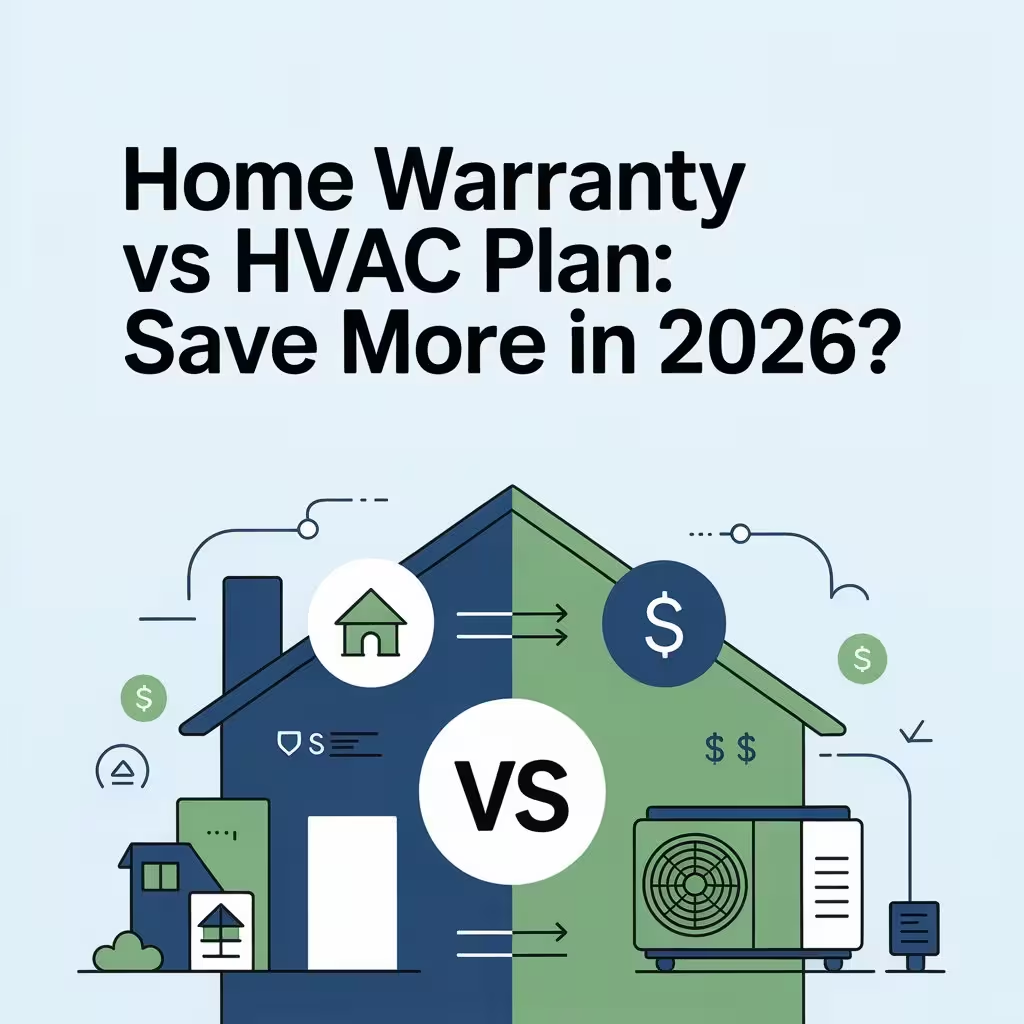
What Is a Home Warranty? (And Why the Fine Print Matters More Than the Brochure)
A home warranty is a service contract not an insurance policy, though it is often marketed like one that pays for the repair or replacement of covered home systems and appliances when they break down due to normal wear and tear. HVAC coverage is typically included in most standard home warranty plans, though the depth of that coverage ranges considerably depending on the provider and tier you choose.
Home warranties became popular with real estate transactions. Sellers would include a one-year warranty as a purchase incentive, and buyers found comfort knowing that a major appliance failure in year one wouldn’t derail their budget. Over time, the product expanded into a standalone market where homeowners renew annually as ongoing protection.
The appeal is intuitive: pay a modest monthly fee and if your $5,000 HVAC system dies, the warranty company covers the replacement. In reality, though, the process is more conditional than that and those conditions are where most homeowner frustration originates.
How Home Warranties Handle HVAC Claims
When your HVAC system fails and you have a home warranty, the process typically works like this:
- You call or log into the warranty company’s portal to open a claim
- The warranty company dispatches one of their contracted service providers you generally don’t get to choose
- The technician diagnoses the issue and submits a report to the warranty company
- The warranty company reviews the claim and decides what, if anything, they will cover
- If approved, they authorize the repair or replacement under their terms, which may include coverage caps
That last point is where many homeowners hit a wall. Coverage caps, limits on how much the warranty company will pay toward a single repair or replacement, can leave you paying thousands out of pocket on a unit that you thought was fully covered.
| Common Home Warranty Claim Denial Reasons for HVAC
• No documented maintenance history: Warranty companies often require proof of annual servicing • Pre-existing condition if the system showed signs of wear before coverage started • Improper installation is common with older systems or those installed by unlicensed contractors • Secondary damage: damage to surrounding components caused by the failed part is often excluded • Coverage cap exceeded: the repair cost exceeds the annual or per-claim limit • Cosmetic or code-related upgrades: many warranties won’t pay for code-required modifications during replacement |
Side-by-Side Comparison: HVAC Maintenance Plan vs. Home Warranty
Before getting into the cost math, it helps to see the structural differences between the two products laid out clearly. The table below reflects what a typical homeowner encounters not the best-case scenario that each company uses in its marketing materials.
| Feature | HVAC Maintenance Plan | Home Warranty |
| Primary Purpose | Prevent breakdowns through routine care | Reimburse repair/replacement costs after failure |
| Coverage Scope | HVAC system only deeply | Multiple systems/appliances shallowly |
| Annual Cost | $150 – $500 per year | $400 – $700 per year + service call fees |
| Service Call Fee | Usually included or minimal | $75 – $125 per call |
| Maintenance Included? | Yes bi-annual tune-ups included | No you pay separately for maintenance |
| Claim Denials | Rare service is proactive | Common if maintenance records are missing |
| Contractor Choice | You choose a trusted local tech | The warranty company assigns their contractor |
| Response Time | Prioritized often same/next day | Dependent on warranty company availability |
| System Lifespan Impact | Extends life by 3–5 years on average | No impact reactive only |
| Energy Savings | Yes tune-ups improve efficiency 5–15% | None |
| Best For | Homeowners who want prevention | Homeowners who want financial backstop |
The Real Cost Comparison: Running the Numbers Over 5 Years
Cost comparisons in this category are often misleading because they focus on the annual premium without accounting for what each product prevents, generates, or excludes over time. The table below uses realistic average figures drawn from industry data on HVAC repair costs, energy efficiency studies, and home warranty claim outcomes.
| Scenario | With Maintenance Plan | With Home Warranty Only |
| Annual plan cost | $300 | $550 + $100 service fee |
| Prevented repair (capacitor failure) | $0 (caught at tune-up) | $150 after deductible |
| Energy savings (10% efficiency gain) | -$180/yr on avg bill | $0 |
| System replacement at age 12 vs 15 | Often still running | May have paid out maybe |
| 5-Year Total Estimate | ~$1,500 | ~$3,500+ |
The key insight here is that maintenance plans generate savings in two ways that home warranties never do: prevented failures and improved energy efficiency. A well-tuned HVAC system running at 95% efficiency instead of 80% can reduce monthly energy bills by $15–$30 in moderate climates and $40–$60 in regions with long cooling or heating seasons. Over five years, that adds up to $900–$3,600 in energy savings alone often more than the cost of the maintenance plan itself.
Home warranties, on the other hand, only engage when something is already broken. They add no value to a system that’s operating well, and their financial benefit depends entirely on whether you have a major failure and whether the claim is approved when you do.
The Maintenance Record Problem Why This Could Cost You Your Warranty Claim
Here is a scenario that HVAC contractors across the country encounter regularly, yet almost no home warranty comparison article addresses it.
A homeowner has carried a home warranty for three years. Their central air conditioning system fails in July the compressor burns out. The repair estimate comes in at $1,800, and the potential replacement cost is $6,500. They file a claim expecting to be covered. The warranty company sends out a technician, who documents the failure and notes visible signs of dirty coils, low refrigerant, and a capacitor that was clearly struggling. The claim is denied not because the policy doesn’t cover compressors but because the failure is attributed to lack of maintenance.
This is not an edge case. Industry data consistently shows that deferred maintenance is among the top reasons HVAC warranty claims are rejected. When a home warranty company denies coverage on grounds of inadequate upkeep, the homeowner is left with the full repair or replacement bill plus the warranty premiums they’ve paid for years.
The implication is significant: having a home warranty without an HVAC maintenance plan may actually leave you in a worse position than having neither. You pay for coverage that won’t perform at the moment it’s most needed.
What Your Home Warranty Actually Covers for HVAC And What It Doesn’t
Every home warranty plan is different, but the exclusions in HVAC coverage follow recognizable patterns. Understanding what a typical plan does and does not cover helps you evaluate whether the annual premium is worth it for your specific situation.
Typically Covered
- Compressor failure due to normal wear
- Fan motor and blower motor failures
- Control board and electrical component failures
- Heat exchanger cracks (some plans)
- Refrigerant recharge up to a stated annual limit
- Ductwork leaks in some premium plans only
Typically NOT Covered
- Routine maintenance filters, coils, tune-ups
- Systems that haven’t been properly maintained
- Pre-existing conditions or known defects at time of coverage
- Damage caused by power surges or improper voltage
- Crane or equipment access fees for rooftop units
- Code upgrades required during replacement
- Secondary damage such as ceiling damage from a condensate overflow
- Units over a certain age typically 10–15 years depending on the plan
- Costs that exceed per-claim or annual coverage caps
That last point deserves more attention. Most standard home warranty plans cap HVAC repairs at $1,500 to $3,000 per claim. Compressor replacements regularly run $1,400–$2,800. Full system replacements run $5,000–$12,000 or more in many markets. If the cap doesn’t cover the repair, you pay the difference and you still owe the service call fee on top of that.
Contractor Choice: A Bigger Deal Than Most Homeowners Realize
One of the most underrated differences between an HVAC maintenance plan and a home warranty is who actually shows up at your door when something goes wrong.
With an HVAC maintenance plan, you select the contractor. You can choose a company based on reviews, certifications, years in business, and whether your neighbors have used them. You build a relationship with a technician who knows your system’s history. When they show up for a tune-up, they’re not a stranger guessing at your system’s quirks they’re someone who documented the refrigerant level last spring and replaced the capacitor two years ago.
With a home warranty, the company controls the contractor dispatch. Their network consists of companies that agreed to their reimbursement rates which are often lower than market rate. This can mean contractors who are less experienced, less responsive, or stretched thin across a large service area. You have no say in who arrives, and if the work is done poorly, your recourse runs through the warranty company rather than directly with the technician.
During peak seasons the first heat wave of summer, the first hard freeze of winter warranty companies can take days or even weeks to dispatch a technician. HVAC maintenance plan customers, on the other hand, are almost always prioritized by their contractor. Some contracts even guarantee same-day or next-day service for active plan holders, which matters enormously when your household is without heating or cooling in extreme weather.
System Age and When Each Option Makes More Financial Sense
Neither product is appropriate for every homeowner in every situation. System age is one of the most important and most overlooked variables in this decision.
Systems Under 5 Years Old
A new HVAC system still under manufacturer warranty has a very low probability of major component failure. The manufacturer warranty typically covers parts, and sometimes labor, for the first 5–10 years depending on brand registration. For a system in this range, a home warranty adds very little value you’re paying for coverage you’re unlikely to need, and the manufacturer warranty already addresses most failure scenarios. An HVAC maintenance plan, however, makes excellent sense at this stage: it preserves the manufacturer warranty (most require documented annual maintenance), builds a service relationship, and protects your energy efficiency from day one.
Systems 5–10 Years Old
This is the window where both products have a reasonable value case. The system is past the point where manufacturer coverage handles most issues, but it isn’t yet in the high-failure-risk zone. A maintenance plan continues to make sense to extend the system’s useful life. A home warranty becomes more defensible here though only if the homeowner is disciplined about keeping maintenance records to avoid claim denials.
Systems Over 10–12 Years Old
Older systems present the most complex calculus. A home warranty on an aging system sounds appealing but comes with important limitations: many warranties cap payouts well below replacement cost, some exclude systems above a certain age entirely, and carriers know that older systems fail more often which is partly why premiums and claim denials both tend to increase on older equipment. At this stage, the most financially sound approach is often to build an HVAC replacement fund, maintain the existing system aggressively to extract every remaining year of useful life, and plan a proactive replacement rather than waiting for a crisis.
When Running Both Makes Sense And When It’s Redundant
Some homeowners assume the smart move is to carry both. In a limited set of circumstances, they’re right. But for most households, doubling up creates financial redundancy without proportionally better protection.
Run Both If:
- Your home has multiple aging systems beyond HVAC water heater, dishwasher, washer/dryer and you want a single policy to backstop all of them
- You are a first-time homeowner in a house with unknown service history and want financial protection while you learn the systems
- You own a rental property where you cannot always coordinate maintenance and want a fallback for tenant-reported failures
- Your HVAC system is in the 8–12 year range and approaching the end of its useful life
Skip the Home Warranty If:
- Your HVAC system is newer than 5 years and still under manufacturer warranty
- You have a strong relationship with a reliable local HVAC contractor on a maintenance plan
- Your home’s other appliances and systems are relatively new
- You have an emergency fund capable of absorbing a $3,000–$5,000 HVAC repair
- You’ve had claims denied in the past due to fine print exclusions
Red Flags to Watch for in Both Products
The HVAC maintenance and home warranty markets each have their share of bad actors. Knowing what to look for protects you from spending money on coverage that won’t deliver.
HVAC Maintenance Plan Red Flags
- No written checklist of what each visit includes vague plans protect the contractor, not you
- Annual contracts with no cancellation clause reputable companies offer 30-day exits
- Technicians who rush through visits in under 45 minutes a proper tune-up takes 60–90 minutes
- No licensed, insured technicians always verify contractor licensing in your state
- Pressure to sign during the first visit before you’ve compared options
Home Warranty Red Flags
- Coverage caps buried in the fine print below the advertised headline benefits
- No disclosure of claim denial rates reputable companies are transparent about this
- Restrictions requiring you to use only their assigned contractors, with no opt-out
- Short or zero waiting periods legitimate policies require 30 days before coverage activates
- Claims processed through an offshore call center with no local escalation path
How to Make the Right Call for Your Household: A Decision Framework
Rather than a blanket recommendation, here is a practical decision path based on your situation:
| Step 1 Know Your System’s Age and Condition
• Under 5 years: Manufacturer warranty + HVAC maintenance plan is the right combination • 5–10 years: HVAC maintenance plan is essential; evaluate home warranty based on budget and other appliances • 10–15 years: Budget for replacement, maximize maintenance, reassess warranty coverage caps carefully • Over 15 years: Direct replacement fund is more reliable than warranty coverage at this age |
| Step 2 Evaluate Your Financial Buffer
• Can you absorb $3,000–$5,000 without financial stress? A maintenance plan alone may be sufficient • Would a $6,000+ HVAC replacement derail your budget significantly? Adding a home warranty has more justification • Do you have other aging appliances and systems? A home warranty covering all of them together may deliver better value per dollar |
| Step 3 Vet Your Local HVAC Contractor
• Do they offer a detailed maintenance plan with a written service checklist? • Are they licensed and insured in your state? • Do they offer priority scheduling for plan holders? • Have they been in business at least 5 years with verifiable reviews? • Will they provide a performance report after each visit you can keep for your records? |
The Bottom Line: Prevention Wins, But Context Determines the Right Combination
If you’re looking for the single option that saves the most money for the most homeowners, the data points consistently toward the HVAC maintenance plan. It is proactive, it extends equipment life, it improves energy efficiency, and it keeps the maintenance records that protect you even if you do carry a home warranty. The home warranty, by contrast, is purely reactive it adds value only when something breaks, and even then only when the claim clears the fine print.
That said, dismissing home warranties entirely ignores the real financial exposure of a system replacement, particularly for homeowners whose systems are aging into the highest-risk years. A home warranty on a 10-year-old system purchased with a clear-eyed read of its coverage caps and exclusions, and backed by documented maintenance history can provide legitimate peace of mind.
The decision isn’t binary. The right answer for your household depends on your system’s age, your financial cushion, the quality of your local HVAC contractor, and how carefully you’re willing to read a contract before you sign it.
What’s certain is this: no home warranty replaces the protection that regular maintenance delivers, and no amount of fine print changes the fact that a well-maintained HVAC system fails less often, costs less to run, and lasts longer than one that’s been neglected. Start there.
