
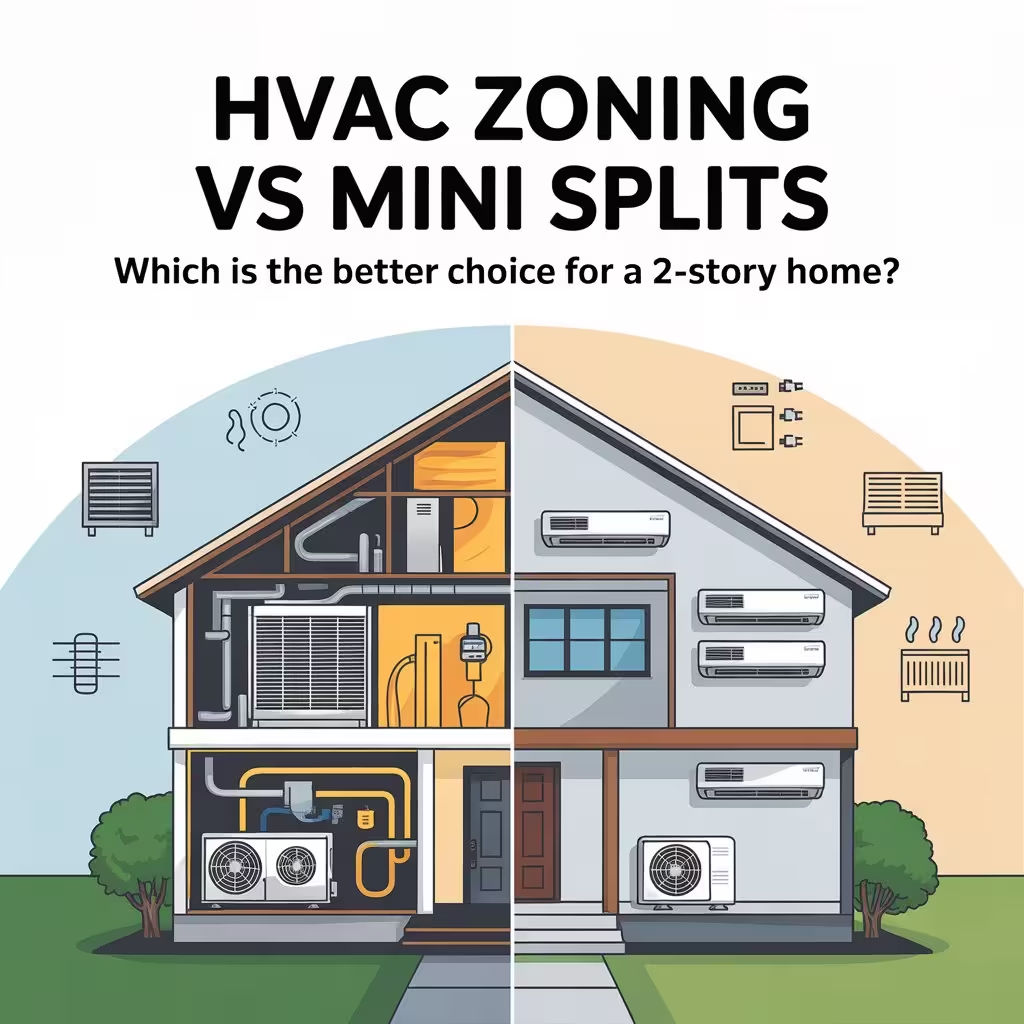
If you own a two-story home in Illinois, you already know the problem without anyone having to name it. The main floor feels fine. Then you walk upstairs, and it’s either sweltering in July or noticeably cooler in January than you’d like. You’ve probably adjusted your thermostat more than once, trying to split the difference and still come up short on both floors.
You’re not dealing with a broken system. You’re dealing with a physics problem that single-thermostat HVAC was never really designed to solve. Heat rises, solar exposure shifts throughout the day, and different areas of a two-story home carry entirely different thermal loads. The result is the kind of temperature inconsistency that’s hard to live with long term.
Two solutions actually address this problem at the roo HVAC zoning vs mini splits. Both let you control temperatures on each floor independently. But they’re fundamentally different in how they work, what they cost, what they require from your home, and which one actually performs better in the Midwest climate.
This guide lays out both systems honestly, not to push one over the other, but to help you understand which one fits your specific situation.
Why Two-Story Homes Struggle With Temperature Balance
Before comparing solutions, it’s worth understanding what’s actually causing the imbalance because the cause shapes the fix.
In a standard two-story home with a single HVAC system and one thermostat, the system responds to what it senses at that one location. If the thermostat is downstairs, it reads the downstairs temperature and shuts off when that zone is satisfied. The upstairs, which has been absorbing heat rising through the ceiling and collecting heat from sun-exposed rooflines and upper windows, keeps climbing.
Research from HVAC technicians and building science professionals consistently shows upstairs rooms can run 3 to 7°F warmer than the thermostat reading in summer meaning a homeowner trying to achieve 74°F upstairs may need to set the thermostat to 67°F downstairs, overcooling the lower level to compensate.
In Illinois specifically, this is compounded by the climate range. Summers push into the high 80s and 90s with significant humidity. Winters routinely drop below zero. A system that can’t distribute loads intelligently ends up working harder than it should in both directions, which shortens its lifespan and inflates your energy bills year-round.
Both HVAC zoning and mini splits exist specifically to solve this. The question is which one solves it better for your home.
What Is HVAC Zoning?
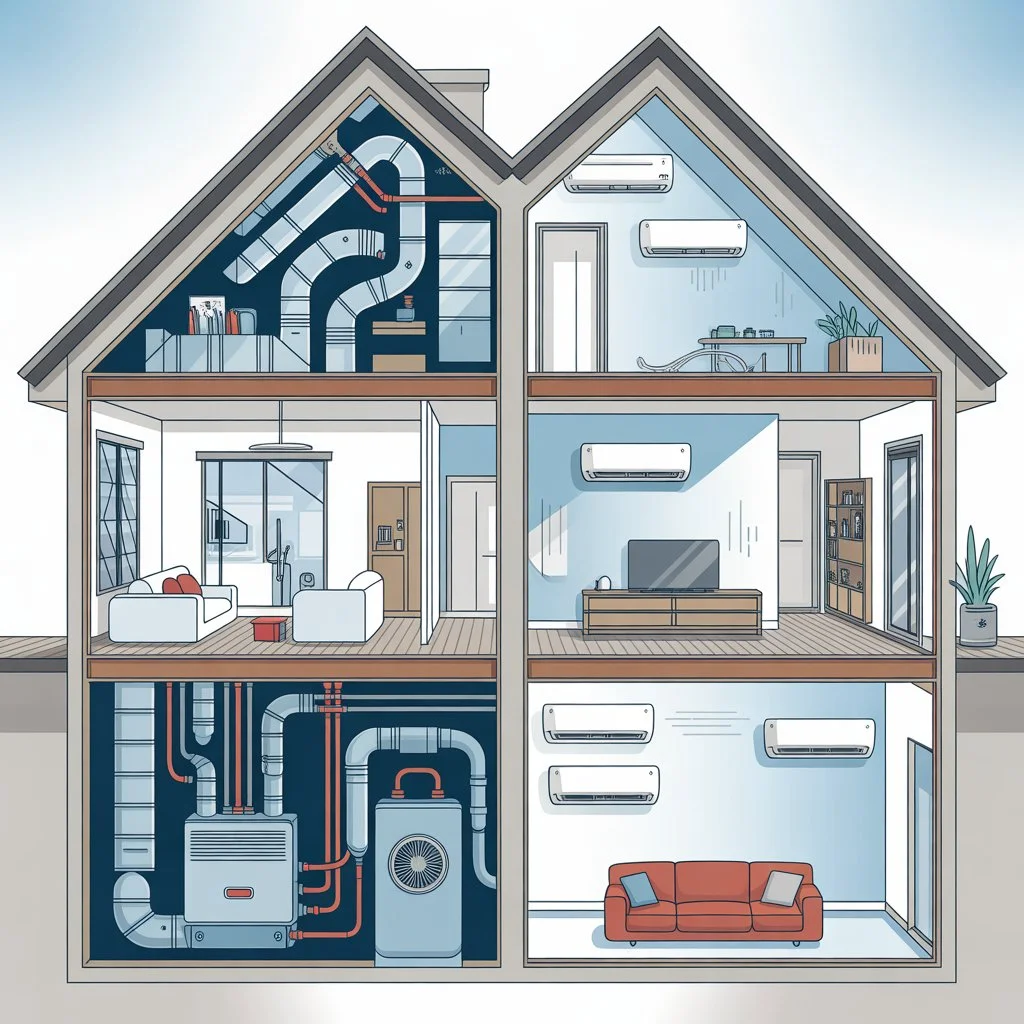
HVAC zoning keeps your existing central heating and cooling equipment but adds intelligence to how that conditioned air gets delivered through your home. Motorized dampers are installed inside your existing ductwork at key branching points. Each zone typically upstairs and downstairs in a two-story layout, though more zones are possible gets its own thermostat. A central zone control panel reads all thermostats and coordinates the dampers accordingly, directing airflow only where it’s needed at any given time.
When your upstairs calls for cooling, the dampers route air predominantly to the upper level. When the downstairs needs heat on a cold morning, airflow is directed there instead. The system cycles between zones based on demand rather than running uniformly throughout the home regardless of where occupants are or which areas need conditioning.
For two-story homes that already have ductwork in reasonable condition, it integrates without tearing into walls or installing new mechanical equipment beyond the dampers, thermostats, and control panel. The furnace and air conditioner you already own keep doing the heavy lifting.
Where zoning performs well: – Homes with existing ductwork that’s in good structural condition – Homeowners who want whole-home conditioning rather than room-by-room control – Situations where the primary problem is floor-to-floor imbalance rather than isolated hot or cold rooms – Two-stage or variable-capacity systems (these pair especially well with zoning because they can modulate output rather than forcing full capacity into a reduced zone)
Where zoning has limitations: A single-stage system the kind that runs at 100% capacity or not at all creates a real challenge with zoning. When only one zone is calling for air, the system is still producing a full volume of conditioned air. The dampers close off the other zone, but that air has to go somewhere. Bypass dampers and dump zones can manage this, but it introduces static pressure issues that an improperly sized or designed system will struggle with over time. This isn’t a reason to avoid zoning, but it is a reason to have a qualified technician assess your current equipment before moving forward.
What Are Ductless Mini Splits?
A ductless mini split operates on a different principle entirely. Rather than conditioning air centrally and distributing it through ductwork, a mini split moves refrigerant between an outdoor compressor unit and one or more indoor air handlers mounted directly in the spaces you want to condition. There’s no ductwork involved a small conduit carrying refrigerant lines and electrical wiring runs through a penetration in the wall to connect indoor and outdoor units.
In a two-story home, a multi-zone mini split system might use one outdoor compressor connected to two or more indoor wall-mounted units one for the main floor, one for the upper level, potentially one for a bedroom or office that has persistent comfort issues. Each indoor unit operates independently with its own thermostat or remote control, and multiple zones can run simultaneously, which a single ducted system cannot do.
Mini splits also operate as heat pumps, meaning they move heat rather than generate it which makes them significantly more efficient than electric resistance heating. Modern cold-climate mini split models from manufacturers like Mitsubishi, Daikin, and Fujitsu maintain useful heating capacity at outdoor temperatures well below zero, which matters in an Illinois winter.
Where mini splits perform well: – Homes without ductwork, or where existing ductwork is deteriorated, undersized, or inaccessible – Additions, finished basements, bonus rooms, or sunrooms that were never properly conditioned – Homeowners who want each zone to operate truly independently, including running multiple zones at the same time – Situations where high efficiency is a priority, particularly if looking to reduce gas dependence – Targeted problem rooms that one or two units can address without a whole-home system change
Where mini splits have limitations: The wall-mounted indoor units are visible in the living space. Some homeowners find this a reasonable tradeoff; others find it aesthetically disruptive. Ceiling cassette options exist and are less obtrusive, but cost more. Multi-zone systems for a whole house also carry significant upfront cost— whole-home ductless installations average around $19,500 nationally before incentives, which is substantially more than retrofitting zoning onto an existing ducted system. Installation is also more involved, often spanning multiple days and requiring new electrical circuits for each outdoor unit.
Side-by-Side: HVAC Zoning vs. Mini Splits for a 2-Story Illinois Home
| Factor | HVAC Zoning | Ductless Mini Splits |
| Requires existing ductwork | Yes | No |
| Upfront cost (2-zone retrofit) | $1,700–$4,500 | $5,000–$19,500+ |
| Operates zones simultaneously | No (one zone at a time) | Yes (fully independent) |
| Installation disruption | Low (mostly in mechanical space) | Moderate to high (multiple rooms) |
| Visible indoor equipment | None | Wall or ceiling units in each zone |
| Cold climate performance | Depends on existing equipment | Excellent (cold-climate models to -15°F) |
| Best for whole-home use | Yes | Yes (at higher cost) |
| Best for additions/no ducts | No | Yes |
| Energy efficiency | Improved over unzoned central | Higher (inverter heat pump technology) |
| Maintenance | Central system + dampers | Per-unit filter cleaning, annual service |
Cost Breakdown: What to Expect in Illinois
HVAC Zoning Installation Costs
Retrofitting a two-zone system onto an existing central HVAC setup typically runs $1,700 to $4,500 for most residential applications. A basic two-zone configuration one for each floor sits at the lower end of that range when existing ductwork is accessible and in good condition. Each additional zone adds roughly $350 to $500 in equipment and labor.
If your ductwork needs modifications, repairs, or bypass damper work to handle the altered airflow, costs increase accordingly. A technician assessing your system before quoting will identify these factors upfront. Multi-zone thermostats run $130 to $600 depending on features, and smart thermostats compatible with zone control systems add convenience without dramatically changing the overall project cost.
Mini Split Installation Costs
Single-zone mini splits for one room or problem area run $2,000 to $7,000 installed, depending on capacity and brand. For a whole-home two-story application, multi-zone systems with two to four indoor units typically land between $5,000 and $15,000+ depending on the number of zones, equipment brand, and installation complexity.
National marketplace data from EnergySage shows whole-home multi-zone ductless installations averaging around $19,500 after state and local incentives are factored in though Illinois-specific pricing varies based on local labor rates and which incentives apply to your situation.
Worth noting for Illinois homeowners: the federal Energy Efficient Home Improvement Credit (Section 25C) offers up to $2,000 as a tax credit on qualifying heat pump installations. State and utility rebate programs can layer on top of this, meaningfully reducing what you pay out of pocket for a mini split system.
Illinois Climate Considerations That Actually Matter
Illinois HVAC discussions can’t be separated from what the climate actually demands. The Chicago metro and much of the Midwest see summer heat index values well above 90°F and winter lows that regularly test any heating system. These conditions create specific considerations that shouldn’t be glossed over.
On the mini split side: Standard heat pump models lose efficiency as outdoor temperatures drop, and some older or lower-tier models struggle below 20°F. Modern cold-climate mini split models — Mitsubishi Hyper-Heat, Daikin’s cold-climate line, Fujitsu’s low-ambient series — are rated to maintain meaningful heating capacity at -15°F or below, which covers nearly everything an Illinois winter delivers. If you’re considering a mini split as a primary heating source in this climate, specifying a cold-climate model is not optional — it’s the only version that makes sense here.
On the zoning side: A zoned central system in Illinois still runs a gas furnace during heating season for most homes. That means reliable, high-output heat at whatever outdoor temperature occurs, without the heat pump efficiency tradeoff in extreme cold. For homes already committed to gas heating that simply want better distribution across floors, zoning doesn’t complicate the cold-weather picture at all.
Humidity management: Illinois summers bring high relative humidity that contributes significantly to discomfort. Both systems can handle dehumidification as part of cooling, but central systems — including zoned setups — often have a slight edge in whole-home dehumidification because they move larger air volumes through a single filtration and conditioning path. Mini splits dehumidify each zone independently, which works well but may feel less consistent if your home has an open floor plan where zones bleed into each other.
Factors That Should Decide the Answer for Your Home
Rather than landing on a universal recommendation, here are the factors that actually determine which system fits your situation:
Choose HVAC zoning if: – You have existing ductwork that’s in good or serviceable condition – Your current HVAC equipment is relatively new or has years of remaining service life – Your primary problem is floor-to-floor temperature imbalance, not isolated rooms – Your budget is focused on getting meaningful comfort improvement without a full system replacement – You prefer no visible equipment in your living spaces – You want a simpler installation that stays mostly out of your daily life
Choose ductless mini splits if: – Your home has no ductwork, or existing ducts are damaged, inaccessible, or significantly undersized – You’re conditioning an addition, finished basement, or detached space that can’t be tied into a central system – You want the flexibility of zones running completely independently at the same time – Long-term energy efficiency and potential electrification of your heating system are priorities – You’re comfortable with the upfront investment and the visibility of wall-mounted indoor units – You have a persistent problem room or area that a single unit could address without a whole-home change
The hybrid approach: Some two-story Illinois homes benefit from doing both — keeping or upgrading the central ducted system for whole-home conditioning, and adding a single mini split unit to a room that consistently underperforms: a master bedroom with southern exposure, a finished attic, or a room over a garage. This is often the most cost-effective path when the central system is otherwise sound.
What Competitors Aren’t Telling You
Most articles comparing these two systems stop at the feature list. There are a few things worth saying plainly that don’t get enough attention:
Zoning doesn’t fix an undersized or poorly designed duct system. If your upstairs has always been uncomfortable, the cause might be undersized ductwork runs to the second floor rather than a zoning problem. Adding dampers to a duct system that wasn’t moving enough air to begin with doesn’t solve the root issue — it may actually worsen static pressure imbalance. A proper Manual J load calculation and duct assessment should precede any zoning work, not follow it.
Mini splits require maintenance that homeowners often overlook. The filter inside each indoor air handler needs cleaning every few weeks during heavy use periods. Units that go uncleaned for seasons accumulate mold, degrade efficiency, and develop odors. This is not complicated work, but it requires attention that a central system with a single filter replacement doesn’t demand as frequently.
Single-stage systems and zoning don’t always pair cleanly. If your current furnace or air conditioner runs at one speed — full blast or off — retrofitting a multi-zone setup requires careful design work to manage airflow pressure when only one zone is calling. A variable-speed or two-stage system handles this much more gracefully. If your equipment is older and single-stage, it’s worth discussing with a technician whether a zoning retrofit makes sense at this point or whether timing it with an equipment upgrade is smarter.
Installation quality determines real-world results for both systems. A mini split installed with improper line set sizing, poor refrigerant charge, or inadequate outdoor unit placement will underperform consistently. A zoning system installed without proper bypass pressure management or damper calibration will create noise, pressure, and comfort problems. The system brand matters less than who installs it and how well they understand your home’s specific load characteristics.
The Bottom Line
For most two-story Illinois homes that already have functioning ductwork, HVAC zoning is the more accessible, lower-cost starting point for solving floor-to-floor temperature imbalance. It works with what you have, keeps installation straightforward, and delivers meaningful comfort improvement without visible equipment changes or significant capital outlay.
Ductless mini splits are the right answer when your ductwork isn’t workable, when you’re conditioning spaces that can’t connect to a central system, when you want zones running independently at the same time, or when long-term efficiency and the flexibility of room-by-room control are priorities you’re willing to invest in.
Neither system is universally better. The right answer is the one that matches what your home actually requires and that starts with having someone who knows HVAC look at your specific setup, not just the floor plan.
Ready to Stop Guessing at Your Thermostat?
If you’ve been managing uneven temperatures in your two-story home by adjusting the thermostat and hoping for the best, there’s a better path. Our Homeright inc team serves homeowners across Illinois and can assess your current setup, evaluate whether zoning or a mini split installation makes more sense for your home, and give you an honest, no-pressure recommendation backed by what we actually find not what’s easiest to sell.
Get your free quote today and find out exactly what it would take to make both floors comfortable, year-round.
