

Most North American homeowners should schedule professional air conditioner service once a year, ideally in spring before the cooling season begins. Homes in hot climates like Texas, Arizona, or Florida or households with pets, allergies, or older systems benefit from service twice a year. In 2026, AI-powered predictive maintenance tools are changing this rule entirely by alerting homeowners before a system fails.
The Question Every Homeowner Asks Every Spring
You wake up on the first truly hot day of the year, reach for your thermostat, and nothing happens. Or worse, warm air pushes through your vents. At that moment, every homeowner asks the same question: Why didn’t I get this serviced sooner?
Here is the truth that most blogs skip past: there is no single universal answer for how often you need air conditioner service in North America. Your answer depends on where you live, how old your system is, whether you have pets, and what type of AC unit is running in your home.
This guide gives you the complete, honest picture, including 2026 industry trends that most competitors have not covered yet.
What Actually Happens During a Professional Air Conditioner Service?
Before deciding how often to schedule a visit, you need to understand what a licensed HVAC technician actually does during a standard AC service appointment. Many homeowners assume it is just a filter swap. It is not.
The Complete 2026 AC Service Checklist
| Refrigerant Check & Leak Inspection | Measures system pressure; detects micro-leaks before they cause compressor failure. |
| Evaporator & Condenser Coil Cleaning | Restores rated SEER efficiency dirty coils reduce performance by 5–40%. |
| Electrical Connection Testing | Tightens loose connections that arc silently and cause premature component failure. |
| Thermostat Calibration | Prevents short-cycling and over-run that inflate your electricity bill every cycle. |
| Condensate Drain Flushing | Prevents water backup, ceiling damage, and ductwork mold growth in summer. |
| Blower Motor Lubrication | Dry bearings fail suddenly always on the hottest day of the year. |
| Full Performance Test Under Load | Confirms the unit hits rated cooling output before the technician leaves. |
Skipping even one of these steps creates a specific, traceable vulnerability. Understanding the full scope of a proper air conditioner service is what makes frequency decisions meaningful not just a number on a calendar.
How Often Should You Schedule Air Conditioner Service? The Baseline Rule
The industry-standard recommendation across all of North America is to schedule professional air conditioner service once every 12 months. Major HVAC manufacturers including Carrier, Lennox, and Trane require documented annual maintenance as a condition of keeping equipment warranties valid.
Annual service should be scheduled between late February and early April, before outdoor temperatures spike and before HVAC companies become fully booked. Scheduling in this window gives your technician time to order any needed parts before cooling demand peaks in June and July
Best Booking Window: Late February through early April before the summer rush and before HVAC appointment slots fill up across North America.
This once-a-year standard is your non-negotiable baseline. Your specific situation, however, may require more frequent professional attention.
When You Should Schedule Air Conditioner Service Twice a Year
Certain households across North America should schedule professional service twice per year once in spring before cooling season and again in fall before heating season begins, particularly if the system doubles as a heat pump.
5 Situations That Require Twice-Yearly AC Maintenance
- You Live in a Hot Climate Zone Residents of Texas, Arizona, Nevada, Florida, Georgia, and Southern California run their air conditioners for eight to ten months of the year. That extended runtime creates double the component wear compared to a home in Minnesota or Ontario, Canada. In these markets, bi-annual air conditioner service is the only way to protect your compressor from a shortened lifespan.
- You Have Pets at Home Pet dander and fur clog air filters and evaporator coils two to three times faster than average. A heavily fouled coil forces your compressor to work harder on every cooling cycle, raises your electricity bill measurably, and accelerates wear on the most expensive component in your entire system.
- A Family Member Has Respiratory Conditions If someone in your home manages asthma, COPD, or severe seasonal allergies, indoor air quality is not a comfort issue it is a health priority. Twice-yearly service keeps filtration running at peak performance and ensures ductwork is not silently circulating allergens, mold spores, or dust mite debris.
- Your system is over ten years old. Aging AC systems develop small mechanical problems between visits that an annual inspection may catch too late. Bi-annual check-ups catch developing issues a worn capacitor, a partially clogged drain, a slightly low refrigerant charge before they escalate into full repairs or premature system replacement.
- You Run Your System Year-Round Some North American climates particularly along the Gulf Coast and the Pacific Southwest require cooling even during winter months. If your system never gets a seasonal rest, it should not wait twelve full months between professional inspections.
The 2026 Shift How AI-Powered Predictive Maintenance Is Changing Service Frequency
This is the development that most competing HVAC blogs have not yet covered, and it is the most significant change affecting how homeowners should think about air conditioner service scheduling in 2026.
Reactive Maintenance vs. Predictive Maintenance
Traditional AC service was reactive. You booked a visit once a year on a fixed calendar schedule, regardless of whether your system actually needed attention at that moment. The standard emerging across North America in 2026 is predictive maintenance, where smart technology monitors your system in real time and identifies service needs as they develop, not as you guess they might.
AI algorithms now analyze operational data patterns and flag potential breakdowns before a system failure occurs. The global predictive maintenance market is expanding from $10.6 billion in 2024 toward $47.8 billion by 2029 a 35.1% compound annual growth rate that reflects how quickly this technology is being adopted across residential and commercial HVAC applications.
What Predictive Maintenance Means for Your Service Schedule
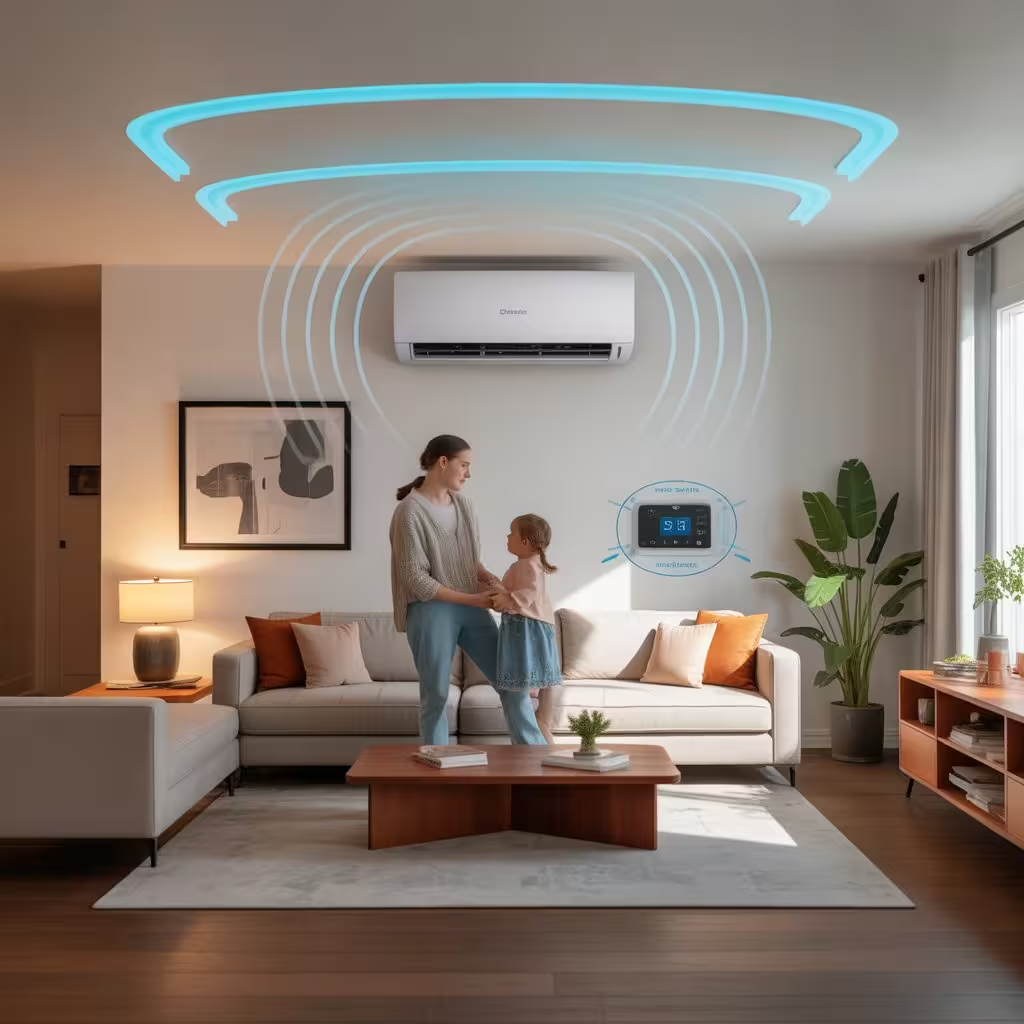
If your AC unit is connected to a smart thermostat or an IoT-enabled monitoring system, it can automatically alert your HVAC provider when refrigerant pressure drops below safe thresholds, when coil fouling begins to reduce airflow efficiency, or when the compressor motor is drawing abnormal electrical current, all of which signal an approaching failure.
These predictive algorithms reduce unnecessary emergency service calls by catching refrigerant losses and coil fouling early, extending equipment life and preventing the catastrophic breakdown scenarios that cost homeowners three to five times more than a routine maintenance visit.
| Market Stat: North America leads the global smart thermostat market with more than 61% of total revenue in 2024. Eight out of ten owners say they would buy another smart thermostat in the future. |
The 2026 Refrigerant Transition and What It Means at Your Next Service Visit
One of the most important technical changes affecting air conditioner service across the United States and Canada in 2026 is the ongoing refrigerant transition and most homeowners do not know it affects their maintenance schedule.
Understanding the EPA R-410A Phase-Out
Starting January 1, 2025, the U.S. Environmental Protection Agency mandated that all new residential and light commercial air conditioners and heat pumps must use low global-warming-potential refrigerants instead of the previously standard R-410A. This is part of the broader American Innovation and Manufacturing Act requirement to reduce HFC refrigerant production by 85% by 2036.
How the Refrigerant Transition Affects Your Service Appointment
If your system was installed before 2025 and still operates on R-410A refrigerant, your technician must handle it under specific updated protocols during every maintenance visit. Dual refrigerant inventories across the supply chain through 2026 are creating scheduling complexity and longer appointment lead times in high-demand markets.
Air Conditioner Service Frequency by North American Climate Zone
North America spans an enormous range of climate conditions, and your maintenance schedule should reflect where you actually live — not a generic nationwide recommendation.
| Region | Frequency | Key Reason |
| Southern US (TX, FL, AZ, GA) | Every 6 months | 8–10 months of runtime; extreme heat stress on compressor |
| Pacific Coast (CA, OR, WA) | Once a year spring | Milder climate; wildfire smoke drives mid-season filter checks |
| Midwest & Great Plains (IL, MN, KS) | Once a year spring | Sharp seasonal swings; spring catches idle-winter issues |
| Canadian Provinces (ON, BC, AB) | Once a year April/May | Short summers but heat domes can be life-threatening |
| Mountain West (CO, UT, NV Highlands) | Once a year + filter check | Dry air drives faster dust buildup on condenser coils |
What Happens When You Skip Air Conditioner Service for Two or More Years?
Most competitors skip this section. Homeowners deserve the honest picture of what neglected air conditioner maintenance actually costs over time.
The Year-by-Year Cost of Skipping AC Service
- After Year 1 Without Service: Filter becomes heavily restricted. Coils accumulate biological matter. Condensate drain partially clogs. Electricity bill rises 10–20% with no visible warning signs.
- After Year 2 Without Service: Sustained airflow restriction stresses the compressor ($1,200–$2,800 to replace). Refrigerant micro-leaks that cost $150 to fix have now caused measurable pressure loss and reduced cooling capacity.
- After Year 3 or More Without Service: You are no longer maintaining a system you are waiting for it to fail. Emergency repairs cost 3–5x more than routine maintenance, and premature replacement typically arrives 5–7 years early.
The Bottom Line: A $120 annual AC tune-up is always less expensive than a $2,800 compressor replacement or a $7,000 full system installation.DIY Air Conditioner Maintenance Between Professional Service Visits
Professional annual service is not a substitute for what you do at home between appointments. These homeowner tasks extend your system’s operating life and protect your comfort between scheduled visits.
Monthly and Seasonal DIY Maintenance Tasks
- Change Your Air Filter Every 30–90 Days A standard 1-inch air filter needs replacement every 30 days. A 4-inch media filter can last up to 90 days. Homes with pets, smokers, or high dust should always use the 30-day interval. Filter neglect is the single most common preventable cause of early AC system failure in North America.
- Keep Your Outdoor Condenser Unit Clear Maintain at least 18 inches of unobstructed airflow around all sides of the outdoor unit. Blocked airflow causes the compressor to overheat under peak summer load, dramatically shortening its operating life.
- Flush Your Condensate Drain Line Quarterly Pour one cup of diluted white vinegar into the drain access port near your indoor air handler. This prevents algae and mold buildup the leading cause of condensate backup and the water damage that follows during humid summer months.
- Check Thermostat Batteries Every Spring A dead thermostat battery is one of the most common — and most avoidable reasons a homeowner believes their air conditioner has stopped working.
- Listen for Unusual Sounds During Operation Grinding, squealing, and rattling during startup are early-warning signs. Catching them early typically means a minor repair. Ignoring them through a full summer almost always results in a significantly larger and more expensive failure.
How Regular Air Conditioner Service Reduces Your Energy Bill
A properly maintained air conditioner operates at its rated energy efficiency. A neglected one does not. Dirty evaporator coils alone reduce system efficiency by 5% to 40%, according to U.S. Department of Energy guidelines.
Heating and cooling together account for roughly 40% of a typical American household’s total utility costs. Any inefficiency in your air conditioner directly impacts one of your largest recurring household expenses compounding across every month of the cooling season.
Energy Fact: If your annual cooling bill is $900 and a dirty system runs at 20% below rated efficiency, you are paying $180 extra every cooling season more than the cost of an annual service visit.
Your 2026 Air Conditioner Service Plan at a Glance
How often do you need air conditioner service in North America? Here is the clear, practical summary.
- Once a year is your non-negotiable minimum. It protects your warranty, maintains your energy efficiency, and prevents the compounding neglect that turns a $120 tune-up into a $4,000 repair or premature system replacement.
- Twice a year is the smarter choice for hot climate zones, systems older than ten years, pet households, and any home where someone depends on clean indoor air for their respiratory health.
- Smart monitoring in 2026 makes both approaches work better. Pairing annual professional service with a connected thermostat and real-time system monitoring gives you the lowest long-term operating cost, the longest possible system lifespan, and the most reliable home comfort regardless of how extreme North American summers continue to become.
